A team at St. Michael's Hospital in Toronto has successfully completed 10 brain angiograms using a robot controlled remotely by a neurosurgeon, paving the way to eventually providing critical stroke care to patients in northern Ontario.
A brain angiogram is a minimally invasive diagnostic procedure where doctors place a catheter in the femoral artery through the groin and thread it up to the brain, then inject contrast dye that allows the medical team to see any problems in the blood vessels with an X-ray.
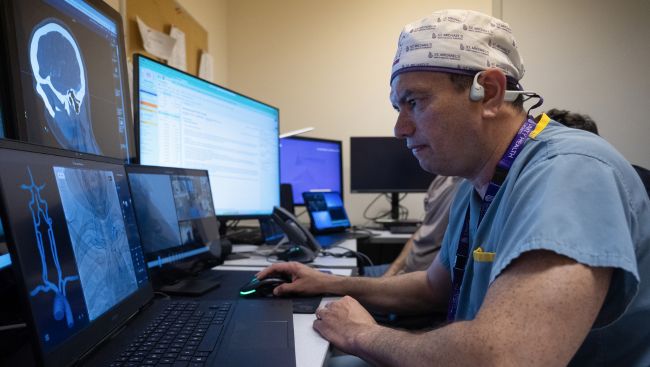
Normally, the doctor is beside the patient manually moving the catheter. But in what the hospital says is a world first, the team performed a series of angiograms where Dr. Vitor Mendes Pereira, head of St. Michael's neurovascular program, used a computer to remotely control a robot to manoeuvre the catheter through the blood vessels in the patient's body up into the brain.
The distance between Pereira and the robot increased gradually throughout the procedures, starting across the room, then from another room in the hospital, and finally from St. Joseph's Health Centre about six kilometres away. St. Michael's and St. Joseph's are both sites of Unity Health Toronto.
His computer and the robot are connected through an "incredibly fast" fibre optic internet connection, Pereira said.
"I didn't see any difference on being here in this (operating) room, in the same building or being in another hospital in terms of visualization and also on the surgical experience," he said.
The next step will be to increase the distance between Pereira and the robot to more than 600 km — the distance from Toronto to the Sault Area Hospital in Sault Ste. Marie, Ont.
After doing more diagnostic angiograms, the team will apply to Health Canada for approval to start a clinical trial using the robotic technology to perform endovascular thrombectomies on stroke patients, using a stent to grab and remove the blood clot in the brain causing the stroke.
Right now, there's no one to perform EVTs at the Sault Area Hospital, so patients who have had a stroke have to be transported to the nearest stroke centre in Sudbury, Ont., which takes anywhere from an hour by Ornge air ambulance to three and a half hours by road.
In many cases, there's a significant wait time for the air ambulance to arrive in Sault Ste. Marie, said Dr. Laura Stone, medical director of the Sault Area Hospital's emergency department.
Every delay in getting treatment after a stroke translates into more neurons dying, which means more disability — or death — for the patient.
"Time is brain," said Stone.
"It's difficult knowing that there is a standard of care and a great procedure available that we can't necessarily offer to our patients here," she said.
"That is a challenging part of working somewhere that's more remote."
But if the Sault hospital has the robot on hand, the EVT can happen there, with Pereira at his computer back in Toronto, remotely steering the catheter and stent into the patient's brain to remove the clot.
The St. Michael's team, led by research program manager and technologist Nicole Cancelliere, will train Sault Area Hospital technologists and other staff on how to set up the robot and insert the catheter.
Dr. Michael Kutryk, who is both an interventional cardiologist and researcher at St. Michael's Hospital and the head of cardiology at the Sault Area Hospital, has been helping to establish the partnership between the two health-care centres.
"It's going to be the difference between somebody being paralyzed and dysarthric — not able to speak — compared to somebody walking out of the hospital two or three days later," he said.
Kutryk estimated that the robot-assisted EVTs could be up and running at the Sault Area Hospital late next year or in early 2027.
"This is kind of a perfect thing to do for a robot because it's so safe in the human hands, there's very little that can go haywire and same with the robot if you're controlling the robot properly," he said.
One of the main risks is if the internet connection between the robot and the surgeon is disrupted, Pereira said, but the connection is rigorously tested and the plan is to always have a backup connection in place.
If there's any delay in the robot responding to his manoeuvres, the procedure could be stopped and the team at the hospital would revert to its regular stroke care, which could include transporting the patient.
Kutryk said it's not practical for the Sault hospital to hire a dedicated neurovascular specialist to be on standby to do EVTs in person, because there are only about 12 to 15 patients who need the procedure a year.
But for those patients, the robotic technology will be "groundbreaking," said Stone.
"We're increasing the speed to these patients getting this life-saving procedure done."
Although Sault Ste. Marie was chosen as the partner hospital for this project, the St. Michael's team hopes their clinical research with the technology will help patients in other remote areas.
"This is maybe a little bit 'Star Wars,' but this is going to be a reality, I think, very, very soon in hospitals around the world, Kutryk said.
The robot used for the brain angiograms was developed by Remedy Robotics, a private company in San Francisco that specializes in cardiovascular interventions.
Picture Courtesy: THE CANADIAN PRESS/Handout - Unity Health Toronto