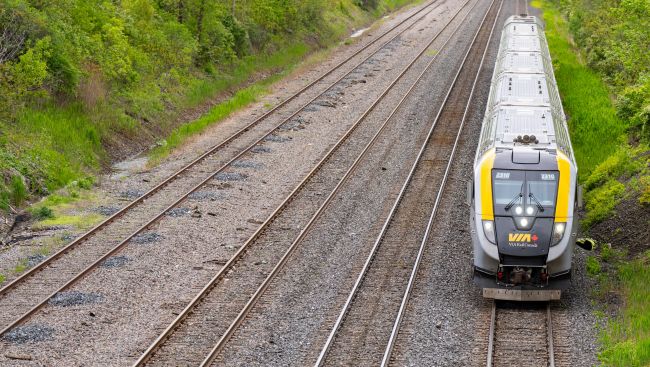
A planned high-speed rail project between Toronto and Quebec City could dramatically increase the number of trains that travel along the corridor each day, according to internal documents.
The Crown corporation responsible for the project has estimated that 72 passenger trains per day could travel through Canada’s most densely populated region if the proposed 1,000-kilometre network is built. The high-speed rail project would slash current travel times and could take passengers from Montreal to Toronto in just three hours.
Draft versions of a 2023 technical briefing, obtained by The Canadian Press through an access-to-information request, show how the Crown corporation, now called Alto, was studying the merits of high-speed rail more than a year before the government announced the project.
An Alto spokesperson confirmed the corporation still believes 72 trains per day is a “reasonable estimate.”
Benoit Bourdeau said Alto’s goal is to have 20 to 30 trains a day in each direction between Toronto and Montreal, compared to roughly eight in each direction currently offered by VIA Rail. He said some will be express trains that will not stop at every station.
“Current planning aims for frequent departures, generally hourly, with the potential for departure every 30 minutes during peak periods, depending on routes,” Bourdeau said.
However, he cautioned that the 2023 figures are working assumptions, not “final service decisions.”
VIA Rail says an average of 39 trains currently transport passengers daily along the various legs of the Quebec City—Toronto corridor.
In February, then-prime minister Justin Trudeau formally unveiled plans for the high-speed rail network, which he called “the largest infrastructure project in Canadian history.” Trains would travel at speeds of up to 300 kilometres per hour along dedicated tracks, powered by electricity.
The announcement marked a shift from the more modest rail project the government had been promising for several years prior: a high-frequency network with a smaller price tag and lower speeds.
In September, Prime Minister Mark Carney announced the government's new major projects office would speed up engineering and regulatory work on the railway. Transport Minister Steven MacKinnon announced last week that the first segment of the high-speed rail network will connect Montreal and Ottawa, and construction is expected to start in 2029.
Alto estimates the full project will cost $60 billion to $90 billion. The government has not yet made a final decision approving funding for the entire rail line.
Back in 2023, the Crown corporation in charge of the project was already considering a pivot from high-frequency to high-speed rail. At the time, concerns were emerging that the public would not support a high-frequency system. In Quebec, provincial and municipal politicians were openly saying they would prefer a high-speed network.
Then called VIA HFR, the corporation completed a preliminary study of a high-speed rail system to calculate cost, journey time, ridership and revenue estimates. A technical briefing, prepared for newly appointed CEO Martin Imbleau in September 2023, compared VIA Rail’s existing passenger rail system with high-frequency and high-speed options.
Though many figures are redacted, Alto released portions of the briefing drafts that indicate 72 trains could travel the Quebec City—Toronto corridor each day by 2039.
The same documents suggest the original high-frequency project might only have seen 58 trains each day along the corridor by 2045 — moving at slower speeds. They also say that just 24 passenger trains were travelling the existing tracks daily at that time, though VIA Rail says its service levels have “evolved considerably” in recent years, following cuts during the COVID-19 pandemic.
A briefing for the prime minister’s office, obtained through a separate access-to-information request, forecasts that there would be 26.5 million annual trips on a high-speed system by 2059, compared to 17.7 million trips on a high-frequency network. That drops to just 6.4 million trips forecasted with existing VIA services.
Ryan Katz-Rosene, an associate professor at the University of Ottawa who studies high-speed rail, said Alto is banking on attracting passengers who might otherwise travel by car or plane, as well as new passengers who might not otherwise travel at all.
But that induced demand “is one of the hardest things to judge,” he said.
“We have no idea of the market context in 2030 and 2035. We also don't have any idea of the competition,” Katz-Rosene said. “Are people going to have autonomous vehicles that would allow them to just hop in the car from their front door and go to their destination?”
But Terry Johnson, president of Transport Action Canada, a transportation advocacy group, said there is a “vast amount of untapped demand” for a rail line that could, for example, allow Torontonians to ride a train to Quebec City for a long weekend.
“There are ways in which this will completely knock people's socks off in terms of what new possibilities it opens up,” he said.
Picture Courtesy: THE CANADIAN PRESS/Christinne Muschi