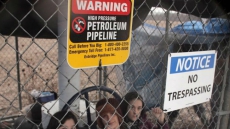
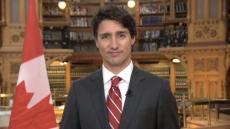
OTTAWA — The federal cabinet's long-awaited decision on the Trans Mountain pipeline expansion is due Tuesday. Here are five things to know about the project.
1. What is it?
There is an existing, 1,150-km pipeline carrying crude and refined oil products from Alberta's oilsands to a terminal in Burnaby, B.C. It transports about 300,000 barrels of oil a day, with refined products including gasoline, diesel and jet fuel making up about 15 per cent of its flows and crude oil the remainder.
The refined products are used mainly in B.C.. About half the crude is sent to Washington state refineries on a different pipeline, and the rest mostly goes to Burnaby. Less than 10 per cent is loaded onto oil tankers. In 2018, 53 oil tankers used the Westridge Marine Terminal, where the pipeline ends.
The expansion, first proposed in 2012, would build another pipeline roughly parallel to the existing one, and be able to carry another 590,000 barrels a day, all of it diluted bitumen. It will require about 980 kilometres of new pipeline and reactivating 193 kilometres of existing pipeline that has not been used for many years. There will also be 12 new pumping stations along the route and 19 new storage tanks at terminals in both Alberta and B.C.
The expansion will use the existing right of way for 73 per cent of the route, and 16 per cent will use right-of-ways granted for other infrastructure including telecommunications, hydro lines and highways. Eleven per cent of the route requires a new right of way.
2. Why do proponents want it expanded?
One of the most common reasons given is that Canada's existing pipeline infrastructure is at capacity, and for Canadian oil producers to expand production, they need either more pipelines or more rail capacity.
The lack of ability to get products out is having some impact on the price Canadian producers can get for the oil, though it is only one of the factors. The hope is also that getting more oil to the west coast will open up the option of Asian markets. Right now 99 per cent of Canadian oil exports go to the United States, which also has an impact on prices.
However, there are no refineries in Asia that can currently handle Canadian bitumen, which needs to be processed first into synthetic crude. Project proponents believe that if there was more product available ,the refineries in Asia would develop to use it because demand for oil in places like China and India is growing. Critics call that expectation a myth and say any extra oil coming from Trans Mountain for export would still end up going to the United States for refining.
3. What is diluted bitumen?
The main product coming out of Alberta's oilsands, bitumen is a thick product close to the consistency of cold molasses. To flow through pipelines, it must be mixed with chemicals to make it less viscous. The resulting product is diluted bitumen, or dilbit for short. It is more expensive to produce, is mined rather than pumped out of oil wells, and the science on how it behaves when spilled is still somewhat scarce.
A major dilbit spill occurred in Michigan in 2010, when an Enbridge pipe leaked more than 3.7 million litres of dilbit into a tributary of the Kalamazoo River. Cleanup efforts took more than five years and a section of the river was closed to recreational use for nearly two years. Natural Resources Canada has concluded that spilled dilbit doesn't sink and may in fact be easier to clean up.
Three years after the Kalamazoo spill, however, Enbridge was ordered to return to the river to remove submerged oil and contaminated sediment. As of 2014, the estimated clean-up cost was more than $1 billion.
4. What is Bill C-69 and how does it relate to Trans Mountain?
Bill C-69 is the federal government's proposed overhaul of the environmental assessment process for major national projects, including interprovincial pipelines and highways, new refineries, electricity grids, airports and offshore wind farms.
The Liberals say it is needed because the process created in 2012 by the former Conservative government was considered to be too weak on Indigenous consultation and environmental protection; under that process the Federal Court of Appeal overturned cabinet approval of the Northern Gateway pipeline and the Trans Mountain expansion.
C-69 has yet to become law and does not apply to Trans Mountain, but it would kick in for any future projects if the Senate passes it this week. Conservative Leader Andrew Scheer has vowed to repeal the bill if he becomes prime minister in the fall. The oil and gas industry says the legislation will prevent another pipeline from ever being approved in Canada, while environment groups argue it brings back some semblance of balance between approving major resource projects and ensuring Canada meets its climate change commitments.
The Senate introduced more than 180 amendments to the bill, many of which would have reduced the requirements for taking into account impacts on Indigenous communities and climate change, and the government rejected more than half the Senate's proposals. The Senate this week will debate the government's response and decide whether it can live with the bill without those amendments.
5. What are the political ramifications of the Trans Mountain decision?
The voices for and against the project are strong. Oil-industry advocates and conservative politicians say the pipeline is a must to keep the oilsands industry going; environmentalists and more left-leaning politicians are adamant that a new pipeline will make it impossible to meet Canada's international climate change obligation to cut emissions almost 30 per cent over the next 11 years.
For the Liberals, who have been trying to balance the economic needs of the oil industry and Alberta, with the concerns about climate change and the environment, the pipeline has proven troublesome. It is part of their "grand bargain" to prove their constant refrain that the "economy and the environment go hand in hand."
Their efforts to appease the oil industry by approving the pipeline and pulling out as many stops as they can to back up that approval — including buying the existing pipeline for $4.5 billion and promising to expand it themselves — have not improved the government's credibility in the oil industry.
Environmental groups that largely supported the Liberals in 2015 are also deeply skeptical. Indigenous communities are also divided over the pipeline, with some who feel if they can get a financial stake in the pipeline it will be a path to economic freedom, and others who worry if there is ever a spill it will have devastating consequences for their traditional way of life.