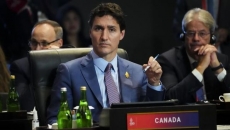
BERLIN - Democracy has not been at its best in recent years, Prime Minister Justin Trudeau told an international audience Wednesday as he called for a recommitment to its principles in the face of Vladimir Putin's invasion of Ukraine.
"At its best, democracy is always stronger than authoritarianism," Trudeau said in a speech to the Munich Security Conference, a Berlin-based international think tank.
"But if we're going to be honest with each other, democracy hasn’t exactly been at its best these past few years," he added. "Even as we're fighting Putin's invasion, we need to recommit ourselves to the work of strengthening our democracies."
Trudeau was in Berlin for meetings with Chancellor Olaf Scholz largely about the response to Russia and ongoing needs to support Ukraine. But from Berlin he spoke by phone to Ukrainian President Volodymyr Zelenskyy to inform him of additional aid Canada is sending.
Trudeau also said Zelenskyy accepted an invitation to address Canada's Parliament. Zelenskyy addressed the British Parliament virtually Tuesday.
On Twitter, Zelenskyy said the conversation with Trudeau focused on how to increase sanctions and pressure on Russia.
"Agreed on further diplomatic steps," he said. "Canada stands with Ukraine. We feel it every day."
It was Trudeau’s first conversation with the Ukrainian leader in six days. Trudeau has praised Zelenskyy's resilience and leadership as his forces try to fend off an invasion by the largest military in Europe.
The call came 14 days after Russian troops began pouring into Ukraine in an invasion the Office of the United Nations High Commissioner for Human Rights says has now killed more than 400 civilians.
On Tuesday, Zelenskyy released a new video showing him standing near the presidential offices in Kyiv in front of piles of sandbags, a few cars and a snow-dusted fir tree.
"Snow fell. It's that kind of springtime," he said, softly. "You see, it's that kind of wartime, that kind of springtime. Harsh. But we will win."
Trudeau praised Zelenskyy in his speech, which was a sequel of sorts to the 2017 address Trudeau gave in Hamburg, Germany, that outlined his foreign-policy vision, and his often professed faith in the rules-based international order.
"President Zelenskyy and the Ukrainian people who are demonstrating so much courage and resilience — they’re not only defending their country, they’re defending the democratic values that are so important to all of us," said Trudeau, who was joined in Berlin by Deputy Prime Minister Chrystia Freeland and Foreign Affairs Minister Mélanie Joly.
"They're standing up to authoritarianism. And Canada and Germany stand with them."
It was Zelenskyy's second video in 24 hours showing him near the country's seat of power, apparently made to dispel any doubts about whether he had fled the city.
After the call, Trudeau paid a sombre visit to Berlin's Platform 17, a memorial that marks the railway station where 50,000 Jews were deported to ghettos and labour and concentration camps during the Holocaust.
The visit was poignant given that Putin, the Russian president, has falsely justified his attack on Ukraine because he says he is trying to save the country from Nazis.
Zelenskyy is Jewish.
Under a crisp blue morning sky, Trudeau walked solemnly along the station's steel platform accompanied by a small entourage that included a guide, Joly and Canada's German ambassador Stéphane Dion.
Trudeau paused silently for a few moments after laying flowers near a plaque at the end of the platform, and made the sign of the cross before leaving. He did not speak to reporters.
Trudeau's discussion with Scholz was the first in-person meeting for the two since Scholz replaced longtime chancellor Angela Merkel in December.
Trudeau announced Wednesday Canada is sending another $50 million in specialized equipment, including Canadian-made cameras for surveillance drones, to help Ukraine defend itself against the Russian invasion.
"We have obtained a number of specialized equipment, including cameras used in drones that a Canadian company makes that we will be able to start sending in the coming days towards Ukraine," Trudeau said during a news conference with Scholz.
Canada previously said it was shipping non-lethal equipment such as body vests and helmets, as well as more than $10 million in weapons such as machine-guns, rocket launchers and hand grenades.
Trudeau acknowledged getting the equipment into Ukraine has not been easy.
"There are challenges at the borders in terms of getting equipment securely across and into Ukrainian hands," he said. "But we are working through that with partners alongside all allies who are facing the logistical challenges that are real, but not insurmountable."
They discussed the need for an immediate ceasefire in Ukraine and a desire to end the war without further escalation. They also talked about energy security in Europe, which is heavily reliant on Russian oil and gas but wants to cut its Russian imports by two-thirds by the end of this year.
The logistics of turning to Canada to replace that energy are difficult, so the conversation on energy appeared to focus more on developing clean technology and future sales to Germany of Canadian-made hydrogen.
Hydrogen fuel technology and development is still in the early stages in both countries.
The Prime Minister's Office said Trudeau will also be meeting with U.S. Vice-President Kamala Harris in Poland on Thursday evening to discuss the situation in Ukraine.