OTTAWA - Prime Minister Justin Trudeau says he is isolating at home after learning that he was exposed to someone who had tested positive for COVID-19.
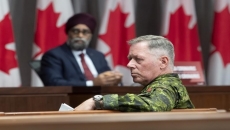
The prime minister said in a tweet Thursday morning that he learned about the exposure the night before, after he had been at a news conference on Parliament Hill with three top ministers.
Trudeau's office says the exposure happened after the event and that no staffer or minister in range of the prime minister are isolating.
Trudeau said the result of a rapid antigen test he took was negative, but he is following local public health rules and isolating for five days.
He said he will be working from home during that stretch.
"I feel fine and will be working from home," he wrote in the tweet. "Stay safe, everyone — and please get vaccinated."
Last night, I learned that I have been exposed to COVID-19. My rapid test result was negative. I am following @OttawaHealth rules and isolating for five days. I feel fine and will be working from home. Stay safe, everyone – and please get vaccinated.
— Justin Trudeau (@JustinTrudeau) January 27, 2022
Staying home for five days will mean the prime minister will not be able to appear in person when the House of Commons returns Monday from its winter break.
Ottawa Public Health guidelines say anyone who does not have symptoms of COVID-19 and tests negative on a rapid antigen test does not need to self-isolate unless they are doing so because of a close contact, like a symptomatic household member.
Trudeau is fully vaccinated and received his booster shot at a local Ottawa pharmacy three weeks ago.
Several of Trudeau's cabinet ministers have had to isolate in recent weeks after positive tests, or because they were potentially exposed to the virus.
Finance Minister Chrystia Freeland was forced in mid-December to deliver her economic update remotely after two members of her team tested positive on rapid tests.
A few days later, Foreign Affairs Minister Mélanie Joly announced she had tested positive on a rapid test and was isolating.
Joly and Freeland were at the news conference with Trudeau on Wednesday, along with Defence Minister Anita Anand. She too had to cancel a trip to Washington, D.C. and isolate after a member of her staff tested positive in mid-December.
The news conference came at the end of a cabinet retreat, where ministers joined remotely.
Trudeau was not scheduled for any in-person events Thursday. He was to call foreign leaders and address the Liberal caucus remotely.
Meanwhile, isolation rules are changing in Saskatchewan. The government said that starting Friday, close contacts of people who test positive will not be required to self-isolate.
The government said it is revising its public health order as it shifts to treating the COVID-19 Omicron variant like other common respiratory viruses such as influenza.
Dr. Saqib Shahab, the province's chief medical health officer, said Omicron is so transmissible that many people who have been able to dodge COVID-19 will get exposed.
"So many of us, on any given time, are notified as a close contact and it's really not feasible for us to isolate every time we're a close contact," he said Thursday.
The change will help children stay in school and workplaces to remain staffed, Shahab said.
All residents who get COVID-19, immunized or not, will need to self-isolate for five days. That eases a 10-day isolation requirement that had been in place for the unvaccinated.
Parents and caregivers will no longer be required to report positive cases to schools, but students are expected to stay home for their entire isolation period.
Ontario tweaked some of its reopening rules to allow snacks and drinks at cinemas, theatres, arenas and concerts when they reopen next week with capacity limits.
Initially, the plan was that food and beverages at those venues wouldn't be allowed until Feb. 21.
Premier Doug Ford announced last week that with public health indicators starting to show signs of improvement, restrictions would be eased in phases starting Monday.
Indoor social gathering limits are to increase to 10 from five and restaurants will be able to reopen their dining rooms at half capacity.
Some non-urgent surgeries are to resume as well.
The province also released guidelines for who is eligible for the antiviral Paxlovid to treat COVID-19. Ontario received its first shipment last week. Health Minister Christine Elliott has said the drug will be used for adults at highest risk: the immunocompromised, unvaccinated people 60 and over, and unvaccinated Indigenous people 50 and over, or who have one or more risk factors.
Public health measures were also being loosened in New Brunswick. Starting Saturday, public venues will be able to operate at half capacity and indoor dining will be permitted at restaurants, also capped at 50 per cent, among other rules.
Premier Blaine Higgs said students are to return to in-person classes Monday. Over the last two weeks, 2,000 portable air filters were placed in 60 schools, he said.
Chief medical officer Dr. Jennifer Russell said the province feels confident moving back to less strict measures because residents held to the rules, which helped blunt the rise of COVID-19 infections and hospitalizations.
In Quebec, officials reported a significant drop in the number of COVID-19 hospitalizations, but 56 new deaths were linked to the virus.
The Health Department said there were 3,153 patients in hospital and those in intensive care dropped to 235, which was 17 fewer than the day before.
The number of infected patients being admitted has dropped by almost one-quarter over the course of a week, said a report by a Quebec government health-care research institute.
The drop, based on data collected between Jan. 15 and 21, was observed in "all age groups and all regions," the report said.
Active cases of COVID-19 appeared to be peaking in First Nations communities, said Indigenous Services Minister Patty Hajdu. The ministry reported 599 active infections across the country.
But booster rates are lagging behind the rest of the country. Fewer than 20 per cent of First Nations adults have received a third shot compared with 41 per cent in the general population.