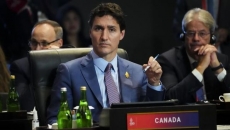
OTTAWA - Prime Minister Justin Trudeau says Canada spearheaded an international declaration denouncing state-sponsored arbitrary detentions because of China's decision to imprison Michael Kovrig and Michael Spavor.
Trudeau made the connection for the first time Friday during a federal election campaign appearance in Windsor, Ont.
In February, when the federal government announced that it had created a coalition of dozens of countries denouncing the practice, it played down any connection that it was specifically targeting China, which has been angered by the declaration, nonetheless.
Foreign Affairs Minister Marc Garneau said at the time the declaration was "country agnostic" and was meant to be a broad denunciation of a coercive practices taking place in numerous countries, including Russia, Iran and North Korea.
But on Friday, when asked about Canada's exclusion from a new American-Australian-British alliance on intelligence sharing in the Indo-Pacific region, Trudeau touted a number of other Canadian geopolitical alliances, including its historic role in NATO and its relatively new effort on calling out state-sponsored arbitrary detention.
"We continue to be there as a strong proponent for multilateralism, including on moving forward on things like the international agreement on arbitrary detentions that obviously stems from the arbitrary detention of Michael Kovrig and Michael Spavor, but that concerns all countries around the world," Trudeau said.
While the government has routinely branded Kovrig and Spavor's arrests by China as arbitrary, and called for their release, it went to great lengths not to portray the new arbitrary-detention initiative as something that was aimed directly at China.
China has accused the two men of being spies, a claim rejected by Canada and its allies. The arrests are widely viewed as retaliation for the RCMP's December 2018 arrest of Chinese high-tech executive Meng Wanzhou on an American extradition request.
The new declaration was born out of a year of behind-the-scenes international diplomacy in 2020 and was led by Garneau's predecessor as foreign affairs minister, Francois-Philippe Champagne. More than 60 countries have since signed on to the new pact, which doesn't have any mechanism to force offending countries to adhere to it.
China has sharply criticized all attempts by Canada to build an international coalition to press it to release Kovrig and Spavor. And it has dismissed the arbitrary-detention declaration as essentially toothless and lacking the support of the majority of countries.
The unexpected new alliance announced earlier this week between the U.S., the U.K. and Australia, known as AUKUS, raised questions internationally, and in Canada and the U.S.
It became an issue on the federal election campaign trail where Conservative Leader Erin O'Toole and NDP Leader Jagmeet Singh criticized Trudeau for Canada's absence from the new pact.
Trudeau shrugged off the criticism, saying Canada continues to be a member of the Five Eyes intelligence-sharing alliance that includes the U.S., Britain, Australia and New Zealand.
He also said the new AUKUS alliance was about bolstering Australia's navy against Chinese ambitions in the region by giving access to American nuclear submarine technology.
"Canada wasn't in the market for nuclear submarines, and therefore, this particular deal didn't involve us," Trudeau said Friday.
David Perry, the vice-president of the Canadian Global Affairs Institute, said the AUKUS alliance is also about closer intelligence sharing, and involves deeper defence industry co-operation and advanced research and development.
"I think it's clearly about more than just subs, and to frame it that way misses an important development," he said.