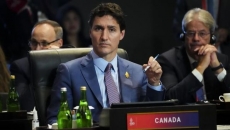
Prime Minister Justin Trudeau urged Canadians to be cautious over the holidays as the country's two largest provinces started taking steps to slow surging cases of the COVID-19 Omicron variant.
"What choices we make as Canadians over the next week or two will determine how bad the rest of our winter is — how many people we lose, how overwhelmed our hospitals get, how much we're going to take a hit in our economy," Trudeau said Thursday during a year-end roundtable interview with The Canadian Press.
Trudeau's warning came as Ontario's science panel released dire predictions and Quebec brought back significant public health restrictions.
He added that Canadians know how to keep each other safe and there is increasing access to booster vaccine shots and rapid COVID-19 tests.
Omicron is a real and serious threat - and it’s here in Canada. If you haven’t gotten vaccinated yet, do that now. And if you’ve gotten both shots and are now eligible for your booster, please, get it.
— Justin Trudeau (@JustinTrudeau) December 16, 2021
"We know what to do," Trudeau said. "We're all grumpy about having to do it again, but we're going to get through this."
Quebec Premier François Legault said vaccinations aren't enough to stop the transmission of Omicron.
Starting Monday in the province, all bars, restaurants, retail stores and places of worship will be limited to 50 per cent capacity. Work parties will be banned, as will dancing and karaoke inside bars, clubs and restaurants.
Legault also reversed a decision to ease indoor gathering limits — keeping the maximum at 10 people over the holidays.
"If everyone does their part, we can get through this together," he said. "I’m counting on you."
Quebec reported 2,736 new daily cases — the highest number since Jan. 8. Legault said health officials on Friday are expected to announce 3,700 new infections.
New modelling indicated that, in a few weeks, Quebec hospitals would begin to fill rapidly and near capacity of dedicated COVID-19 beds.
Ontario's science table, a group of experts advising the province on the pandemic, also released new data that shows public health measures must cut contacts in half if the province is to avoid having 10,000 daily cases before the holiday season.
Table co-chair Dr. Adalsteinn Brown warned that the Omicron variant is an incredible threat that could lead to "the worst wave of the pandemic yet."
Brown said slowing the spread requires a quick and extensive response, including a "circuit breaker," until people can get their booster.
"We do have a tremendous amount on which to base hope, not least of which are the vaccines," said Brown.
"But it must be hope built on action. Anything we can do now — whether as an individual or a province — can help."
Ontario reported 2,421 daily cases — its highest since mid-May. It also had nine more COVID-19 deaths, pushing Canada past a grim milestone of more than 30,000 deaths since the pandemic began.
Canada's chief public health officer, Dr. Theresa Tam, wrote in an annual report on the state of Canada's public health that the pandemic has exposed long-standing cracks in the system.
"The public health system lacks the necessary resources and tools to carry out its critical work and is the subject of 'boom and bust' funding cycles that leave us ill-prepared in the face of new threats," Tam wrote.
The report said it is too early to know how the new variant will affect Canada's pandemic response.
Canada surpassed 25,000 COVID-19 deaths in May and vaccination efforts across the country slowed the deadly pace.
With the emergence of the Omicron variant, COVID-19 modelling shows infections could rapidly increase and health experts warned more hospitalizations and deaths could follow.
In Saskatchewan, Premier Scott Moe urged residents to be cautious. But, he added, it doesn't mean they have to stay home.
Starting Monday, the province is to open booster shots to eligible residents over the age of 18. The time required between second and third doses is reduced to three months from five.
Moe said case numbers in Saskatchewan are reasonable at the moment, but his government is preparing for Omicron.
"I would like nothing more to never talk about COVID again, but I also know that we're being faced with yet another challenge here," he said.
"I just once again would say that Saskatchewan people are much stronger than this virus and we are going to find our way through it."