OTTAWA — U.S. President Donald Trump upped the ante on Canada's supply-managed dairy system over the weekend as he repeatedly warned that the country would face repercussions unless it is dismantled.
Here's what you need to know about supply management, including why Trump wants to get rid of it — and why federal governments of all stripes have said no:
The Basics
Supply management in its current form has been around since the 1970s and applies to three main segments of the farming industry: dairy, eggs and poultry.
The system basically limits production by allowing only a certain amount of each to be produced. The idea is to keep the market from getting saturated, which aims to keep prices stable and ensures steady incomes for farmers.
The system also limits imports by slapping tariffs on imports beyond a certain level. For dairy products, those tariffs can be steep: nearly 300 per cent for butter and cream, and 240 per cent for cheese, whole milk and yogurt.
There are approximately 12,000 dairy producers in Canada, with about 80 per cent of production in Ontario and Quebec. As for cross-border trade, the U.S. sold $631 million in dairy to Canada in 2016 while Canada sold $112 million to the U.S.
The Pros and Cons
Trump is far from the first to attack supply management in Canada, particularly when it comes to dairy; New Zealand and Australia threatened to keep Canada out of the Trans-Pacific Partnership (TPP) if it didn't change its ways.
Critics of the system, which includes many people inside Canada, say it poses a barrier to the completion of ambitious free-trade deals with other countries, with the government having to give up on other areas to protect the industry during negotiations.
It also drives up the cost of dairy, eggs and chicken for consumers, which opponents of the system allege has had an unfairly disproportionate impact on low-income families.
The Canada West Foundation, a Calgary-based think tank that advocates for an end to supply management, estimated last year that the average Canadian household pays $600 more for milk and chicken than in the U.S.
Proponents, however, say the system protects Canadian farmers from the type of price fluctuations that have ravaged other segments of the agricultural industry and eliminates the need for government bailouts.
They also argue the system is better at protecting food safety and produces higher quality products, and that the U.S. and other countries have their own protections in the forms of direct and indirect subsidies for farmers.
A study by trade consultants at Grey, Clark, Shih and Associates and commissioned by the Dairy Farmers of Canada earlier this year estimated the U.S. government provided $22 billion in subsidies to the dairy sector in 2015.
Sylvanus Kwaku Afesorgbor, an expert on agricultural economics at the University of Guelph, said whether Canada continues with supply management should ultimately depend on the balance of pros and cons.
"What are the costs and benefits to Canada," Afesorgbor said. "That is how we should analyze whether Canada should continue implementing some of these supply-management policies."
The Politics
But it's difficult to separate supply management from politics.
Trump first took aim at Canada's supply-managed dairy industry last year during a visit to Wisconsin, where local farmers reportedly complained about not being able to sell their products in Canada.
The issue has since taken on a life of its own, with the president repeatedly railing against supply management as an example of what he is says is Canada's unfair trade practices towards the U.S.
Exactly why Trump has latched onto the issue so strongly remains debatable: some suggest he is using it as an excuse to hit Canada with tariffs on steel while others say his attacks resonate with voters in key parts of the U.S.
The Harper Conservatives did talk about eliminating supply-managed dairy in 2015 as part of a TPP deal, which whetted the appetite of U.S. industry, said Christopher Sands, director of the Center for Canadian Studies at Johns Hopkins University.
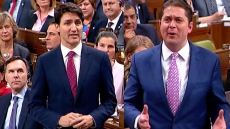
But the Liberals have followed in the footsteps of most other federal governments and refused to budge, with Trudeau telling reporters Thursday: "We will always defend our supply management system because it works."
What the prime minister didn't mention was that any attempt to dismantle the dairy system would create a political uproar, particularly in the Liberal heartland of Ontario and Quebec, where most producers are located.
"Obviously Stephen Harper could afford to give up dairy supply management because he had very few seats in Quebec and a budgetary surplus and it was in the context of a multilateral agreement with the TPP," Sands said.
"For Justin Trudeau ... there are fewer things he can get in exchange, there isn't money to splash around to get farmers who have a quota to give it up and this is an important issue in Quebec, which provides many seats for the Trudeau government."