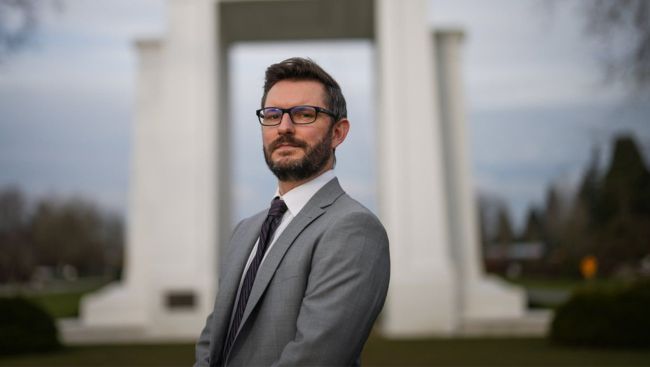
For more than a decade, Wisconsin native Douglas Cowgill has helped Americans in Canada navigate the complex task of renouncing their U.S. citizenship, cutting themselves loose from that nation's Internal Revenue Service in the process.
But it was only in 2023 that Cowgill — a dual citizen at the time with a Canadian wife and family — took the plunge himself.
The lawyer based in Surrey, B.C., has no regrets.
"I had to look at it from the perspective of what lies ahead of me for the next 20 to 30 years, and definitely that is a life here in Canada," said Cowgill, 39.
"I look at it more from the lens of choosing to be Canadian only, and am happy to focus on my life here in Canada."
He's far from alone, and lawyers in Canada involved in U.S. citizenship renunciation say inquiries have spiked sharply since the election of U.S. President Donald Trump last November.
Cowgill, a lawyer with Cross Border Visas says monthly inquiries nearly doubled in December and he expects applications will rise this year.
Alexander Marino, director of U.S. tax law at Moodys Tax Law in Calgary, said that most people renounce U.S. citizenship for tax reasons — the U.S. is one of the few countries that imposes tax based on citizenship, not residency.
This often involves expensive reporting and filing obligations that include estate and gift taxes, even after death.
Marino is also expecting a Trump bump in business.
"I can't deny that most U.S. expats, in my experience, tend to be more left-leaning than right-leaning. For a lot of people, the election results are a bit of the straw that broke the camel’s back," Marino said.
"We're seeing a bump due to the election results."
Marino said he has seen year-over-year demand increase since specializing in renunciation 12 years ago.
He said the spike in interest now is greater than in 2017 after Trump's first presidential win, and he expected 2025 to see a record number of people try to give up U.S. citizenship.
Moodys typically offers five to seven renunciation information webinars each year for U.S. citizens living in Canada; this year, they may schedule up to 12, Marino said.
Anyone giving up U.S. citizenship shouldn't expect the matter to be secret — the U.S. Federal Register publishes quarterly lists of everyone who has surrendered their citizenship. In May 2014, the list named singer Tina Turner, and in February 2017, future British prime minister Boris Johnson.
There were only a few hundred names on the lists in 2005, but numbers have risen sharply since 2014, when the Foreign Account Tax Compliance Act went into full effect. It requires that foreign financial institutions report on the foreign assets held by U.S. account holders.
In 2016, about 4,100 names were listed, but the next year, in Trump's first year in the White House, numbers jumped by more than 50 per cent to about 6,900 names.
Last year, the number of people who expatriated had dipped to 5,500.
The process of renouncing U.S. citizenship can be complicated, involving immigration filings, tax-compliance submissions and a US$2,350 administrative fee to obtain a Certificate of Loss of Nationality.
Some applications result in an exit tax or immigration issues, so many people hire lawyers to ensure they take all the right steps.
The process also involves a formal interview at a U.S. embassy or consulate general, where an applicant is asked why they want to surrender their citizenship, and must take an oath or affirmation of renunciation.
"I hereby absolutely and entirely renounce my United States nationality together with all rights and privileges and all duties and allegiance and fidelity thereunto pertaining," it reads.
Wait times for an interview in Vancouver are around four or five months, Cowgill said.
But in 2023 the Canadian queue was up to 12 months long. So he flew to Reykjavik, Iceland, for his in-person interview.
He had moved to B.C. in 2012 on a work permit, becoming a dual citizen in 2019.
It was during the pandemic, when it was difficult for his Canadian wife to join him across the border to visit his parents in Washington State, that he decided he no longer wanted or needed to be American.
"I'm probably more logical and financially motivated. A lot of clients might be more politically motivated and so if they really don't see themselves in the United States anymore and they see it going in a direction that they're not satisfied with, that could be a huge driver for a lot of people," Cowgill said.
"It feels different when I return to the U.S. When I was a citizen, I crossed the border armed with knowledge that I could never be refused entry. Whereas now, the agents have discretion to refuse my entry, if they believe I am not merely visiting the U.S."