.jpg)
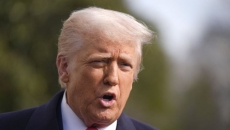
U.S. President Donald Trump said on Wednesday that at some point the automobile tariffs slapped on Canadian imports could increase while also indicating his administration is working on a deal with Canada.
"I put tariffs on Canada, they are paying 25 per cent but that could go up in terms of cars," Trump said in the Oval Office. "When we put tariffs on, all we are doing is we are saying, 'We don't want your cars, in all due respect.'"
Trump put 25 per cent tariffs on all imports of automobiles to the United States earlier this month. It included a partial carveout for vehicles made under the Canada-U.S.-Mexico Agreement, called CUSMA, where only non-American components of a finished vehicle will be hit with levies.
Tariffs on vehicle parts are set to hit no later than May 3.
Trump said he doesn't want Canada to play a part in the U.S. automobile industry and claimed America's northern neighbour was taking vehicle businesses.
The automobile industry has long been integrated between Canada and the U.S. with a deep history of co-operation. Vehicle parts cross the border multiple times before completion.
While Henry Ford was building the bedrock of the American car industry in the early 1900s in Michigan, across the river John and Horace Dodge started up a bicycle company in Windsor, Ont., that would eventually become the recognizable brand — Dodge. The Ford Motor Co. of Canada was founded in Walkerville, Ont., in 1904, importing U.S. parts for assembly.
The integration was deepened with the 1965 Auto Pact trade deal between Canada and the U.S.
CUSMA was negotiated during the first Trump administration to replace the North American Free Trade Agreement and included increased protections for the automobile industry.
The Center for Automotive Research in Michigan said earlier this month that tariffs will result in USD $107.7 billion in increased costs for all U.S. automakers, including USD $41.9 billion to the Big Three — Ford, General Motors and Chrysler, now part of Stellantis.
The Big Three have been lobbying the president but Trump has remained committed to the duties saying the companies must return all manufacturing to the U.S.
Ottawa changed its retaliatory measures in response to Trump's auto tariffs last week so that automobile companies that continue to manufacture vehicles in Canada get an exemption. Auto manufacturers will be allowed to import a certain number of U.S.-assembled vehicles — ones that comply with CUSMA — free of the countermeasure tariffs.
The number of tariff-free vehicles a company is permitted to import will drop if there are reductions in Canadian production or investment.
Canada was a main target of Trump's ire after he won last year's election and was among the first countries to be hit with devastating duties. Canada is also being targeted with fentanyl-related tariffs, as well as 25 per cent levies on steel and aluminum.
The president has been quieter about his criticisms of Canadain recent weeks as he expanded his trade war to the world with "reciprocal" tariffs. The largest levies were given a 90-day pause a few hours after they were implemented but most countries are still hit with a 10 per cent universal tariff.
Trump also hit China with 145 per cent tariffs and Beijing countered with 125 per cent duties on U.S. goods.
Trump declined on Wednesday when asked to comment on the upcoming Canadian election but said he has had good conversations with Prime Minister Mark Carney.
"He was very, very nice I will say. We had a couple very nice conversations, very good," Trump said. "But I don't think it's appropriate for me to get involved in their election."
Carney and Trump spoke by phone late last month and the prime minister has said the president agreed to begin negotiations on a new economic and security agreement after the election.
Trump Wednesday repeated his claims that the United States doesn't need anything from Canada, it should become a U.S. state and called former prime minister Justin Trudeau a "governor." Trump also complained about trade deficits but said he's "working well with Canada."
"We're doing very well," Trump said. "We are working on a deal. We will see what happens."