WASHINGTON (AP) — President Donald Trump plans to impose tariffs on Canada and Mexico starting Tuesday, in addition to doubling the 10% universal tariff charged on imports from China.
In a Truth Social post Thursday, Trump said illicit drugs such as fentanyl are being smuggled into the United States at “unacceptable levels" and that import taxes would force other countries to crack down on the trafficking.
“We cannot allow this scourge to continue to harm the USA, and therefore, until it stops, or is seriously limited, the proposed TARIFFS scheduled to go into effect on MARCH FOURTH will, indeed, go into effect, as scheduled,” the Republican president wrote. “China will likewise be charged an additional 10% Tariff on that date.”
The prospect of escalating tariffs has already thrown the global economy into turmoil, with consumers expressing fears about inflation worsening and the auto sector and other domestic manufacturers suffering if Trump raises import taxes. But Trump has also at times engaged in aggressive posturing only to give last-minute reprieves, previously agreeing to a 30-day suspension of the Canada and Mexico tariffs that were initially supposed to start in February.
The threat of tariffs frightened the stock market with the S&P 500 index falling 1.6% on Thursday. The S&P 500 is now just 1.4% higher than it was after Trump won the election in November, giving up almost all of the gains that the president once cited as evidence of an economic revival.
Asked Thursday about the fact that tariffs are largely paid for consumers and importing companies, Trump dismissed any concerns by saying: “It's a myth.” It's possible for a stronger U.S. dollar to offset some of the costs of tariffs, but Trump's statement goes against most economic modeling given the breadth of his planned taxes.
Trump intends to put 25% tariffs on imports from Mexico and Canada, with a lower 10% tax on Canadian energy products such as oil and electricity. The move, ostensibly about drug trafficking and immigration, led Mexico and Canada to respond by emphasizing their existing efforts to address these issues. Canada created a fentanyl czar, and Mexico sent 10,000 members of its National Guard to its border with the United States.
Mexican President Claudia Sheinbaum said Thursday that she hoped to speak with Trump after the Cabinet-level meetings occurring in Washington this week. Mexico’s Foreign Affairs Secretary Juan Ramón de la Fuente was scheduled to meet with Secretary of State Marco Rubio on Thursday afternoon.
Trump, “as you know, has his way of communicating,” Sheinbaum said. But she said that her government would stay “cool-headed” and optimistic about an agreement coming together to avoid the tariffs.
“I hope we are able to reach an agreement and on March 4 we can announce something else,” she said.
She said Mexico’s security chiefs were discussing intelligence sharing with their American counterparts that would allow for important arrests in the U.S. On the economic front, she said Mexico’s goal is to protect the free trade pact that was negotiated during the first Trump administration between Mexico and the United States. That 2020 deal, which included Canada, was an update of the North American Free Trade Agreement from 1994.
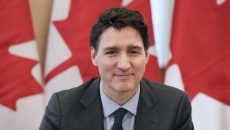
Canadian Prime Minister Justin Trudeau said his country has invested more than 1 billion Canadian dollars to improve border security, adding that his government's ministers and officials are also in Washington this week.
“There is no emergency for the United States at the border with Canada when it comes to fentanyl, and that is exactly what we are demonstrating at this time,” Trudeau said in Montreal. “If the United States goes ahead and imposes tariffs, we already shared the details of our plan. We have $30 billion worth of U.S. products that will be subject to tariffs. And $125 billion of tariffs that will be applied three weeks later. But we don’t want to be in that position.”
Trump did impose a 10% tariff on China for its role in the manufacturing of chemicals used to make fentanyl, and that tax would now be doubled, according to his social media post.
On Thursday, China’s Commerce Minister Wang Wentao wrote to Jamieson Greer, the newly confirmed U.S. trade representative, that differences on trade should be resolved through dialogues and negotiations.
The 25% tariffs on Mexico and Canada would amount to a total tax increase on the U.S. public of somewhere between $120 billion to $225 billion annually, according to Jacob Jensen, a trade policy analyst at the American Action Forum, a center-right think tank. The additional China tariffs could cost consumers up to $25 billion.
The potential for higher prices and slower growth could create political blowback for Trump, who promised voters in last year's presidential election that he could quickly lower the inflation rate, which jumped during Democratic President Joe Biden's term. But Trump also campaigned on imposing broad tariffs, which he plans to launch on April 2 by resetting them to match the taxes that he determines are charged by other countries on American goods.
“The April Second Reciprocal Tariff date will remain in full force and effect,” Trump said as part of his new social media post.
In an interview with News Nation, Kevin Hassett, the director of the White House National Economic Council, said progress by Mexico and Canada on fentanyl “was not as impressive as the president had hoped.” There are significant differences between Canada and Mexico on the scale of drug smuggling. U.S. customs agents seized 43 pounds (19.5 kilograms) of fentanyl at the Canadian border during the last budget year, compared with 21,100 pounds (9,570 kilograms) at the Mexican border.
Hassett stressed that the reciprocal tariffs would be in addition to the ones being placed on Canada and Mexico.
Trump indicated Wednesday that European countries would also face a 25% tariff as part of his reciprocal tariffs. He also wants separate tariffs on autos, computer chips and pharmaceutical drugs that would be levied in addition to the reciprocal tariffs.
The president already announced that he's removing the exemptions on his 2018 steel and aluminum tariffs, in addition to planning taxes on copper imports.
The prospect of a broader trade conflict should other nations follow through with their own retaliatory tariffs is already spooking U.S. consumers, potentially undermining Trump's promise to unleash stronger economic growth.
The Conference Board reported on Tuesday that its consumer confidence index had dropped 7 points to a reading of 98.3. It was the largest monthly decline since August 2021, when inflationary pressures began to reverberate across the United States as the economy recovered from the coronavirus pandemic. Average 12-month inflation expectations jumped from 5.2% to 6% in February, the Conference Board noted.
“There was a sharp increase in the mentions of trade and tariffs, back to a level unseen since 2019,” said Stephanie Guichard, a senior economist at the Conference Board. "Most notably, comments on the current administration and its policies dominated the responses.”