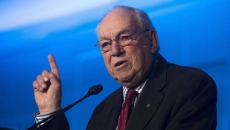
U.S. President Donald Trump said Monday that 25 per cent across-the-board tariffs on imports from Canada and Mexico, with a lower 10 per cent levy on Canadian energy, will start Tuesday, tipping the continent into a trade war.
"No room left for Mexico or for Canada (to make a deal)," Trump said at the White House.
Trump's executive order to implement economywide tariffs was delayed until Tuesday after Canada and Mexico agreed to introduce new security measures at the border.
A White House official confirmed on background Monday that the wording in the executive order means the tariffs would kick in at midnight.
The order initially tied the tariffs to the illegal flow of people and drugs across the borders — but Trump previously said the delay would allow time for an “economic” deal.
"What they’ll have to do is build their car plants, frankly, and other things in the United States, in which case you have no tariffs," Trump said Monday when asked how the countries could avoid the duties.
Trump later added that deadly fentanyl continues to flow into the United States from Canada, Mexico and China.
Foreign Affairs Minister Mélanie Joly said if the levies go into force, Ottawa will revive its previously announced plan for retaliatory tariffs. Those were to begin with an initial 25 per cent levy on $30 billion in U.S. products, with duties on another $125 billion in goods to follow three weeks later.
"We are ready," Joly said as she entered a Canada-U.S. cabinet committee meeting in Ottawa Monday.
Canadian officials and premiers made a month-long diplomatic push in Washington but it remains unclear what Canada could do to persuade Trump to drop the tariff threats for good.
Joly said Canada has responded to the president's concerns about the border. She said she will be meeting with Prime Minister Justin Trudeau when he returns from London, where he met with King Charles.
Canada named a new "fentanyl czar," listed Mexican cartels as terrorist groups and launched a Canada-U.S. joint strike force to combat organized crime, fentanyl and money laundering. More helicopters and drones were launched and additional officers were tasked with guarding the border.
The president's comments came just hours after a key member of his team said no decision had been made and tariff levels could still be lowered.
U.S. Commerce Secretary Howard Lutnick told CNN on Monday morning that Canada and Mexico had done a good job on enhancing border security but more needed to be done to stop the flow of fentanyl.
New York State Gov. Kathy Hochul said the small volume of drugs that may be coming across the northern border does not "justify the cataclysmic impact that tariffs will have."
"This is such an extreme remedy that is going to have a ripple effect across our entire economy," Hochul said on CNN Monday.
U.S. Customs and Border Patrol data shows the number of people and drugs crossing illegally into the United States from Canada is minuscule compared to the volume coming across the southern border. It reports just 13.6 grams of fentanyl seized by northern Border Patrol staff in January.
Republican strategist Doug Heye said that "Trump wants to be able to declare a victory — regardless of what that victory may be — and is using tariff threats to leverage that victory."
"But we know that should (the tariffs) go into effect, they become a de facto tax increase on American families who can ill afford higher costs on anything," Heye added.
A report issued by the Peterson Institute for International Economics last month said Trump's tariffs on Canada, Mexico and China would cost the typical U.S. household more than US $1,200 a year.
Treasury Secretary Scott Bessent called that report "alarmist." On CBS’ Face the Nation on Sunday, Bessent called Trump's plan "holistic" and said "there will be tariffs, there will be cuts in regulation, there will be cheaper energy."
Many Canadian officials have said that Trump's ongoing tariff threats are tied to an upcoming mandatory review of the Canada-U.S.-Mexico Agreement. The continental trade pact was negotiated under the first Trump administration to replace the North American Free Trade Agreement.
Trump returned to the White House in January with a growing tariff agenda.
He ordered 25 per cent tariffs on all steel and aluminum imports into the United States on March 12. Trump signed an executive order to implement "reciprocal tariffs" by raising U.S. duties to match the tax rates that other countries charge on imports starting April 2.
Trump also floated the idea of imposing tariffs on automobiles and signed executive orders to look into levies on copper and lumber.
On Monday, he added agricultural products to his growing list of tariff targets.
"To the Great Farmers of the United States: Get ready to start making a lot of agricultural product to be sold INSIDE of the United States," Trump posted on social media. "Tariffs will go on external product on April 2nd. Have fun!"