

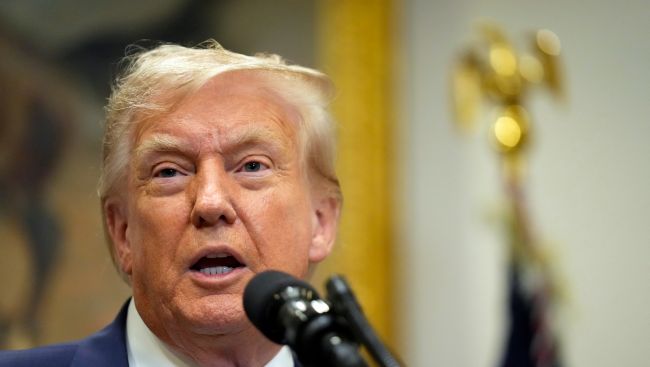
U.S. President Donald Trump has signed an executive order pushing tariffs on Canada to 35 per cent beginning on Friday, following through on a threat to raise duties if Ottawa didn't make a trade deal.
The White House confirmed the tariffs would not hit goods compliant with the Canada-U.S.-Mexico Agreement on trade, commonly known as CUSMA.
A fact sheet from the White House said Canada "failed to cooperate in curbing the ongoing flood of fentanyl" and also pointed to Ottawa's implementation of retaliatory tariffs.
Canadian officials had been tempering expectations that a trade deal would materialize ahead of Trump's deadline and Prime Minister Mark Carney has said he'll only make an agreement that is good for Canada.
Trump said earlier Thursday he had not "spoken to Canada" but did reference that "he's called" — suggesting Carney may have reached out hours before the 35 per cent tariff was set to hit.
The Canadian Press has contacted Carney's office for confirmation but has not yet received a response.
Ontario Premier Doug Ford posted on social media that "Canada shouldn’t settle for anything less than the right deal." He repeated his call for the federal government to respond with a 50 per cent tariff on U.S. steel and aluminum.
"Now is not the time to roll over. We need to stand our ground," Ford said.
Trump dampened the prospect of a deal with Canada in a post on social media early Thursday morning that said it would be very hard to make a deal after Carney announced Wednesday that Ottawa intends to recognize a Palestinian state.
Trump told reporters at the White House that he "didn't like that" but that it was "not a deal-breaker."
When asked about the holdup in Canadian negotiations, Trump said "they have to pay a fair rate." The president also misrepresented agricultural duties, complained about Canadian military spending and said Canada has been treating the United States badly for years.
While Trump didn't mention fentanyl, the White House fact sheet focused on the drug to justify increasing the tariffs.
"Given Canada’s continued failure to arrest traffickers, seize illicit drugs, or coordinate with U.S. law enforcement and Canada’s retaliation against the United States for the President’s actions to address the unusual and extraordinary threat to America, further presidential action is necessary and appropriate to protect American lives and the national security and foreign policy of the United States," the White House said.
U.S. government data shows a miniscule amount of fentanyl is seized at the border with Canada compared to Mexico.
Ottawa responded to Trump's concerns of cross-border trafficking with a $1.3 billion boosted border plan.
Ottawa appointed a "fentanyl czar" and announced a Canada-U.S. Joint Strike Force to combat organized crime, fentanyl trafficking and money laundering, and deployed additional helicopters and drones along the border.
Trump announced a 90-day extension on trade talks for Mexico Thursday after a phone conversation with President Claudia Sheinbaum. He said it was because the "complexities of a Deal with Mexico are somewhat different than other Nations because of both the problems, and assets, of the Border."
"Additionally, Mexico has agreed to immediately terminate its Non Tariff Trade Barriers, of which there were many," Trump said.
In a separate executive order Thursday Trump increased his so-called "Liberation Day" tariffs on many other nations, with those duties to be implemented in seven days.
The order applied to 68 countries, as well as the 27-member European Union, which negotiated its new tariff rate in a deal announced earlier in the week. Countries that were not listed would face a baseline 10 per cent tariff.
While Trump continued to claim in posts on social media that tariffs are making "America GREAT & RICH Again," the president's main tool for realigning global trade faced some sharp questions from federal appellate judges in court earlier Thursday.
The Trump administration's lawyer argued in the U.S. Court of Appeals for the Federal Circuit that there are still checks and balances on the president's powers and he has the authority to use a national security statute to impose duties — despite the fact that the word "tariff" is found nowhere in the International Economic Emergency Powers Act of 1977.
The act, usually referred to by the acronym IEEPA, gives the U.S. president authority to control economic transactions after declaring an emergency. No previous president had ever used it for tariffs and the U.S. Constitution reserves power over taxes and tariffs for Congress.
Members of the 11-judge panel on Thursday repeatedly questioned the Trump's administration's justifications for using IEEPA to implement the so-called "Liberation Day" and fentanyl-related tariffs
"If the president says there's a problem with our military readiness and he puts a 20 per cent tax on coffee, that doesn't seem to necessarily deal with (it)” said Chief Circuit Judge Kimberly Moore.
No decision was issued from the bench Thursday and a White House spokesperson has said the case is expected to go before the Supreme Court.
Picture Courtesy: AP Photo/Mark Schiefelbein


