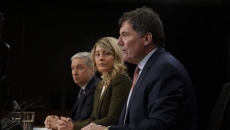
Prime Minister Mark Carney said Donald Trump's tariff regime will "fundamentally change the global trading system" after the U.S. president exempted Canada from his so-called "liberation day" tariff list unveiled on Wednesday.
"In a crisis, it's important to come together and it's essential to act with purpose and with force, and that's what we will do," Carney said in Ottawa on Wednesday.
Trump announced a 10 per cent baseline tariff on imports from most countries and higher duties on dozens of nations he said run trade surpluses with the U.S. Those higher tariffsinclude a 20 per cent levy on imports from the European Union, a 25 per cent tariff on South Korea and a 32 per cent levy on Taiwan.
The White House said Canada and Mexico remain under previous economywide duties the president has linked to the flow of fentanyl across the borders and are not subject to Trump's latest tariffs.
In early March, Trump imposed — and then partially paused — 25 per cent across-the-board tariffs on Canada and Mexico, with a lower 10 per cent levy on energy and potash.
A White House fact sheet issued Wednesday said goods imported under the Canada-U.S.-Mexico Agreement on trade, known as CUSMA, will still not face tariffs. Imports that fall outside the continental trade pact are hit with the 25 per cent tariff.
If that fentanyl-related executive action ends, imports that fall outside CUSMA would drop to 12 per cent tariffs, the fact sheet said.
As Liberal leader, Carney paused his federal election campaign Wednesday to take part in meetings with his Canada-U. S. relations council and a cabinet committee. He will meet with the premiers Thursday morning.
The prime minister said that while Canada wasn't hit with the latest levies, it's still subject to 25 per cent tariffs on steel and aluminum and 25 per cent duties on automobile imports which will come into force on Thursday.
The automobile tariffs have spread confusion throughout the deeply integrated North American auto market.
A White House official confirmed Monday cars made under CUSMA rules will be hit with devastating duties until a systemis set up to gauge how much of each finished car is made with American components. When that system is in place, tariffswill only hit the value of non-American parts.
Trump has promised his massive tariff agenda will boost manufacturing in the United States — but Carney said it willhave a negative impact on both the U.S. and Canadian economies.
"The series of measures will directly affect millions of Canadians," Carney said. "We are going to fight these tariffswith countermeasures, we are going to protect our workers and we are going to build the strongest economy in the G7."
Ontario Premier Doug Ford said the signals Wednesday from the White House were positive and reflected his efforts to press Canada's case through meetings with Trump administration officials and American media interviews.
"This all goes back to relationships," he said. "I've always believed that in business and government, you have to build a relationship. I believe we have built it."
Saskatchewan Premier Scott Moe said that "for now, it appears that Canada’s approach of a co-ordinated, strong and measured response while continuing to engage with U.S. government officials at all levels has been successful."
Alberta Premier Danielle Smith called the tariff news "an important win for Canada and Alberta" but said there is still work to be done on the Canada-U.S. trade relationship.
New Brunswick Premier Susan Holt was less optimistic. She told reporters Wednesday the uncertainty, pain and stress of the past few months isn't going away.
"You don’t treat your neighbours like this," she said.
Canada's case against the duties was taken up in the U.S. Senate Wednesday, where lawmakers narrowly voted to pass a resolution to end the emergency at the northern border — a largely symbolic move that saw a handful of Republicans rebuke Trump's tariffs.
Democrats forced the vote on Trump's use of the International Economic Emergency Powers Act, also called IEEPA, to declare an emergency over fentanyl trafficking in order to hit Canada with tariffs. Democrat Sen. Tim Kaine called it a "made-up emergency."
U.S. government data shows that only a very small amount of fentanyl is seized at the northern border. The Annual Threat Assessment report, released last week, does not mention Canada in its section on illicit drugs and fentanyl.
Susan Collins, a Republican senator from Maine, said that Canadian "neighbours" are working with American law enforcement and the problem of fentanyl at the northern border is minor. She said the Maine economy is intertwined with Canada's and the tariffs would be devastating for businesses and families in her state.
While the Democrats' resolution has passed the Senate, it probably won't stop Trump's emergency declaration because it's not likely to come up in the House, where Republicans have indicated they won't push against the president's tariff agenda.
Trump said on social media earlier Wednesday that "it is not going anywhere because the House will never approve it and I, as your President, will never sign it."
— With files from Dylan Robertson in Ottawa, Allison Jones in Toronto and Hina Alam in Fredericton
This report by The Canadian Press was first published April 2, 2025.