As war rages on in the Middle East, a new Leger poll suggests most Canadians believe the government of Canada should remain neutral, while one in four say Canada should support the United States and Israel in their attacks on Iran.
The poll, which was conducted online and can't be assigned a margin of error, surveyed 1,608 Canadians between March 13 and March 16.
Respondents were asked to indicate their level of agreement with several statements about what the Canadian government's position should be on the Iran war.
Sixty-seven per cent of Canadians said Ottawa should remain neutral and not support either side, while a quarter of respondents said the government of Canada should support the United States and Israel.
Thirteen per cent of those polled said Canada should support Iran, while another 13 per cent said Canada should attempt to support both sides of the conflict.
Andrew Enns, Leger's executive vice-president for Central Canada, told The Canadian Press it's possible some Canadians believe this conflict is another "rash decision" by U.S. President Donald Trump.
"There's lots of questions around the rule of international law," Enns said. "I think you see that almost reflected a bit in the numbers in the sense that people, I think, quite frankly like us to be neutral.
"But then you do have that swath of Canada that sort of says Iran's a bad country, maybe we should be more supportive."
Men were far more likely than women to say Canada should support the U.S. and Israel in their attacks on Iran — 33 per cent, compared to 18 per cent of women.
Liberal and Bloc Québécois voters were more likely to say Canada should remain neutral — at 77 per cent each, compared to 53 per cent of Conservative voters.
Conservative voters were more likely to say Canada should support the U.S. and Israel in their attacks on Iran, at 45 per cent, compared to 18 per cent of Liberal voters.
"It almost puts the government in a bit more of a difficult spot because I think you see that a little bit in how the prime minister and the minister of defence are being very careful, choosing their words and sometimes getting caught up in terms of what they say," Enns said.
"I think it's challenging for them because I think their supporters want a much more categoric, 'This is really bad, we should be taking a strong stand against it.'"
Respondents were also asked to say if they support or oppose the U.S.-Israeli war on Iran, based on what they have read heard or seen about the conflict.
Fifty-eight per cent of Canadians said they oppose the war, while 25 per cent said they support it.
The poll also surveyed 1,006 Americans between March 13 and March 16. When asked the same question, 44 per cent of American respondents said they oppose the campaign, while 38 per cent said they support it.
More than three in four Republican voters said they support the airstrikes on Iran, compared to 15 per cent of Democrat voters.
Canadian respondents were also asked if they were concerned about the Iran conflict threatening Canada.
Seventy per cent said they're concerned about the prospect of an increased risk of a terrorist attack in Canada.
Sixty-nine per cent said they're worried about Canadian military members being pulled into the conflict.
Ninety-one per cent of Canadians said they're concerned about the cost of gasoline and groceries increasing.
And 82 per cent said they're worried about the threat of a global economic recession leading to job losses in Canada.
"Canadians just don't feel that they've recovered from some of that really high inflationary period," said Enns. "I think seeing the rising gas prices and wondering and worrying about what that means for food prices down the road is disconcerting."
The poll also asked respondents if they would support the Canadian government committing ground troops to the Iran conflict in various circumstances.
Almost 60 per cent said they would support sending troops to defend a NATO member country attacked by Iran.
Fifty-four per cent said they'd support the deployment of troops to protect oil refineries and shipping to ensure the global economy is not threatened.
Almost 40 per cent said they'd support deployment to back efforts by a coalition of countries to change the regime in Iran.
Canadians aged 55 and older were more likely to support backing a NATO member, at 69 per cent, compared to 57 per cent of Canadians aged 35 to 54 and 45 per cent of Canadians aged 18 to 34.
The poll asked respondents if Canada should immediately take steps to expand oil and natural gas production capacity to make up the global shortfall caused by the war.
Almost three-quarters of Canadians said yes, while nine per cent said no and 17 per cent said they didn't know.
The polling industry's professional body, the Canadian Research Insights Council, says online surveys cannot be assigned a margin of error because they do not randomly sample the population.
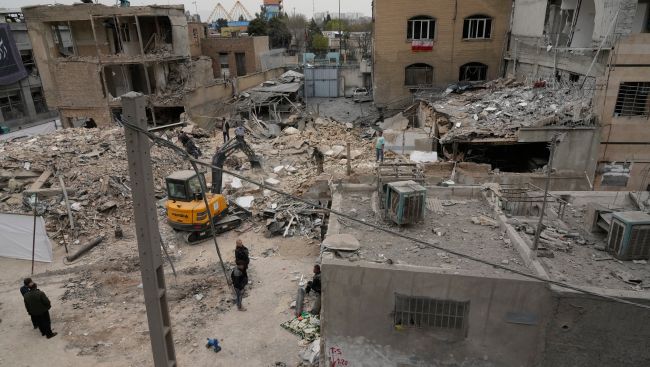
Picture Courtesy: AP Photo/Vahid Salemi