Sunday, December 21, 2025
ADVT 
National

Two-thirds favour keeping two-metres physical distance: Leger poll

Darpan News Desk The Canadian Press, 23 Jun, 2020 08:43 PM
  • Two-thirds favour keeping two-metres physical distance: Leger poll

Two-thirds of Canadians don't want to relax physical distancing rules imposed to curb the spread of COVID-19, a new poll suggests.

And even if they were relaxed, a strong majority wouldn't be comfortable taking part in activities that would bring them closer to other people, like going to a movie theatre.

Sixty-six per cent of respondents to the poll, conducted by Leger and the Association for Canadian Studies, said two metres should remain the safe distance kept between people, as recommended by Canada's public health authorities.

Just 12 per cent favoured reducing the distance to 1.5 metres, as is required in many European countries, and only 10 per cent favoured a reduction to one metre, the minimum recommended by the World Health Organization.

If the physical distancing rule were reduced to one metre, just 40 per cent said they'd be comfortable dining in a restaurant, 28 per cent going to a movie theatre, 24 per cent to a gym and 21 per cent to a bar or night club.

"We've been schooled on two metres for over three months now," said Leger executive vice-president Andrew Enns.

"It's difficult for Canadians to now suddenly start to be convinced that it's OK to make that a closer distance."

The online poll of 1,521 adult Canadians was conducted June 19 to 21. It cannot be assigned a margin of error because internet-based polls are not considered random samples.

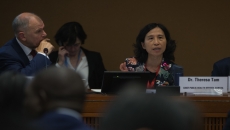
Canada's chief public health officer, Dr. Theresa Tam, said Tuesday that she and her provincial counterparts are constantly reviewing their recommendations for safe physical distancing but, for now, agree that two metres should remain the rule.

"The two-metre distance is based on the usual sort of way droplets that are emitted from people, if they're coughing or sneezing et cetera, fall to the ground or fall on top of someone else," she said.

"The bottom line is that one metre catches a whole bunch of droplets. Two metres, there will be more droplets that you may be able to avoid if you kept the two-metre distance."

Enns said the reluctance to get closer with their fellow Canadians reflects a "very persistent level of anxiety" about the deadly new coronavirus that causes COVID-19, despite a steady decline in the number of new cases in Canada.

Just 43 per cent of respondents said they believe the first wave of the pandemic is over and 74 per cent think there'll be a second wave, according to the poll. And 51 per cent said they are very or somewhat afraid of contracting COVID-19.

Forty-two per cent said they believe the worst of the crisis is over but an equal number said we're in the worst of it now or the worst is yet to come (10 per cent and 32 per cent, respectively).

Almost half (46 per cent) said they find it very or somewhat stressful to leave the house and go out in public.

Sixty-two per cent said it will take time before life returns to normal, while 28 per cent said it will never return to normal.

All those measures of continued anxiety about COVID-19 are likely contributing to people saying "I'm not going closer than two metres because this thing's not over," Enns said.

MORE National ARTICLES

Horgan tells workers stay home if sick after COVID-19 outbreak at chicken plant

Horgan tells workers stay home if sick after COVID-19 outbreak at chicken plant
B.C. Premier John Horgan says people who are sick must stay away from work after an outbreak of COVID-19 at a chicken processing plant in Vancouver. Horgan said Wednesday workers should not go to work when they are sick because they fear losing wages, and that he was planning a meeting with Labour Minister Harry Bains and WorkSafe BC officials to discuss sick pay provisions.

Horgan tells workers stay home if sick after COVID-19 outbreak at chicken plant

Search for missing B.C. woman prompts homicide fears, second death

Search for missing B.C. woman prompts homicide fears, second death
Police are releasing more details about a British Columbia woman they fear may be the victim of a homicide. Metro Vancouver's Integrated Homicide Investigation Team says 45-year-old April Parisian was last heard from on March 28 and was declared missing earlier this month.

Search for missing B.C. woman prompts homicide fears, second death

Reports of hate crimes are up in Vancouver: police

Reports of hate crimes are up in Vancouver: police
An assault on a 92-year-old Asian man with dementia in Vancouver is being investigated as a hate crime and police say they have recently noticed an increase in reports of hate-motivated incidents. Vancouver police say the man has "severe dementia" and wandered into a convenience store on March 13 when another man yelled racist remarks that included comments about COVID-19.    

Reports of hate crimes are up in Vancouver: police

More signs COVID-19 is slowing in Canada; students to get federal help

More signs COVID-19 is slowing in Canada; students to get federal help
Chief Public Health Officer Dr. Theresa Tam said Canada was making progress in slowing the epidemic but warned against letting down its guard. The focus, Tam said, must be placed on stopping outbreaks in places like seniors homes and in other places where vulnerable populations live together in close quarters. How exactly Canada gets on the road to normalization will largely depend on the provinces, Prime Minister Justin Trudeau said on Wednesday. However, the closure of the Canada-U.S. border will stay in place until May 21st at least, he said.

More signs COVID-19 is slowing in Canada; students to get federal help

Prime Minister Justin Trudeau defends not creating universal COVID-19 benefit, announces student aid

Prime Minister Justin Trudeau defends not creating universal COVID-19 benefit, announces student aid
As he announced yet another emergency financial aid package Wednesday — this one aimed at students — Prime Minister Justin Trudeau defended his decision not to create a universal benefit that would ensure no Canadians affected by COVID-19 fall through the cracks. His focus for specific help Wednesday was students, announcing a $9-billion suite of programs for students whose education and job prospects are disrupted by the novel coronavirus.  Trudeau says his government's approach has been to try to target its emergency financial assistance in stages to those who need it most, rather than to everyone at once, including those who don't need it.      

Prime Minister Justin Trudeau defends not creating universal COVID-19 benefit, announces student aid

What BC is doing to fight COVID-19

What BC is doing to fight COVID-19
B.C. declared a provincial state of emergency on March 18, a day after announcing a public health emergency, and it has been extended to April 28. The measure gives the province authority to take any action necessary to protect people and communities, including charging people who ignore public health orders.

What BC is doing to fight COVID-19