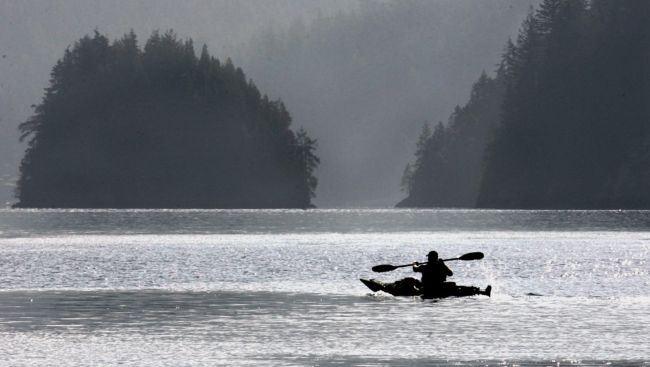
A U.S.-based outdoor group has been paddling in British Columbia's coastal waters for almost 30 years, running sea-kayaking courses and camping along the coast.
But an application by the non-profit National Outdoor Leadership School to renew and expand its licence in B.C. has run into choppy waters as residents and First Nations groups object, some citing concern about Canadian sovereignty.
BC Assembly of First Nations Regional Chief Terry Teegee said in a statement that it was "unthinkable" to consider "leasing" Crown lands to U.S.-based organizations at a time when Canada was asserting sovereignty amid American political threats.
"Leasing our lands to foreign companies for commercial gain — without our free, prior, and informed consent — cannot be justified," said Teegee in the statement issued by the First Nations Leadership Council.
The B.C. government says the National Outdoor Leadership School is seeking a "licence of occupation," not leases, and that such an application is not unique.
"Over the past five years, the province has received 213 applications for adventure tourism tenures," the Ministry of Water, Land and Resource Stewardship said in a statement.
But the First Nations Leadership Council said in its statement that the province should consult with them before granting access to 77 sites being eyed by the U.S. company as potential overnight camping locations.
The council said the locations encompass ancient village sites, and that it was "gravely concerned" the applicant failed to acknowledge First Nation title and rights holders.
Hugh Braker, a political executive with the First Nations Summit, said in an interview that the nations have rights on the west coast of Vancouver Island, and the Supreme Court of Canada has said that when First Nations interests are going to be involved or affected, there has to be consultation.
"The first thing you have to do is consult with First Nations," said Braker, who is a citizen of the Tseshaht First Nation in Port Alberni on the West Coast of Vancouver Island. "We have not seen a start to that consultation."
Mariah Charleson, chief councillor of the Hesquiaht First Nation on the west coast of Vancouver Island, said two of the proposed camp sites are on their northern boundary with the Mowachaht/Muchalaht First Nations, but nobody has approached them about the plan yet.
"And without us being at the table, it would be impossible for us to support something of this nature," said Charleson.
The National Outdoor Leadership School said it had been offering wilderness education since 1965, including running sea kayaking courses in B.C. waters for almost 30 years.
Asked about its application, it provided a fact sheet, saying it had operated on Crown lands in the B.C. Coast Mountains since 1998 and along the central coast since 1995.
It says it operates in B.C. as a registered society, and it was applying to renew a permit to run one sea-kayaking course in B.C. waters per year, with a maximum of 10 participants.
If allowed, it wanted to have the group kayak "the entire B.C. coast" before ending in Alaska between May and August next year, with its previously licensed area expanding from three zones of the coast to five.
"Many campsites in our application would not be used unless necessary to evacuate due to weather or sea-state emergencies," it said.
It is seeking a permit to operate for up to 90 days, the actual time spent around Vancouver Island, from South Pender to Port Hardy, at15 to 20 nights, it said.
While the National Outdoor Leadership School website says it offers courses for military members, a spokeswoman said the trip planned for next year would only be open to the school's course graduates, and "is not related to the military or government."
The company said it chose Vancouver Island's waters for its kayaking courses because it is an area the organization "has loved and appreciated for decades."
The company said it practised "minimum impact camping," and followed the BC Marine Trails Code of Conduct, which is designed to guide responsible recreation.
But Braker said he was worried about giving access to the remote areas to outsiders, citing both concerns for traditional food supplies and the U.S. political scene.
"We're just as concerned as anybody else about the actions of the president of the United States," he said.
Braker added that Canadians shouldn't be giving land access to Americans when "they're trying to hurt us so much."
He also raised concerns about whether the group could protect the local environment from its impact.
"What are they gonna do with their sewage? People have day-to-day needs, and they need space to put their sewage," said Braker.
The BC Ministry of Water, Land and Resource Stewardship said in a statement that it is aware of the concerns raised by the council, and no decision has been made on the license application.
"Consultation must also occur with First Nations. For the licence of occupation application from the National Outdoor Leadership School, this consultation is in its early stages," read the statement.
The ministry said granting the license of occupation does not convey exclusive use of Crown land, and it won't prevent public use.
The public is invited to have its say on the application until Oct. 5.
Picture Courtesy: THE CANADIAN PRESS/Chuck Stoody