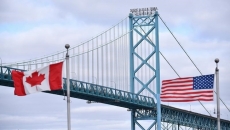
If trade deals were football players, Canada's agreement with the United States and Mexico would have been considered a second-stringer a year ago compared to President Donald Trump's original Hail Mary effort to secure a new pact with China.
But now that COVID-19 has rendered China an international pariah and touched off a global movement to "reshore" manufacturing capacity, the U.S.-Mexico-Canada Agreement suddenly finds itself in the spotlight — and under pressure to bring home a win.
"Serendipitous is the right word," said Pedro Antunes, chief economist of the Conference Board of Canada, of the political and economic conditions that will greet the USMCA when it comes into force July 1.
"There's a lot of talk of shortening supply chains, bringing supply chains domestically, and I see that as playing out in favour of Canada's relationship with the U.S. — perhaps strengthening that relationship and those trade ties within North America, within Canada and with the U.S. economy."
The agreement — known in official Canadian circles as CUSMA or ACEUM, T-MEC in Mexico and "the new NAFTA" pretty much everywhere else — was forged during an arduous 13 months in 2017 and 2018, long before "pandemic" would become a household word across North America. This summer, it will make its debut in a world dramatically different than that of its predecessor.
In the U.S., where Trump is shrugging off a COVID-19 death toll that surpassed 100,000 on Wednesday and aggressively cheerleading a rapid return to business as usual, the White House is now clearly counting on the USMCA, as well as its signatories, to help lead the North American recovery.
"Once the economies get on their feet you’re going to see … a real pickup in trade. Canada and Mexico are very important trade partners," Trump economic adviser Larry Kudlow said earlier this week.
"USMCA is, by the way, twice the trading activity — two-way trading — that China is, so my answer to you is yes, it’s going to add quite a lot to GDP and jobs."
There is, of course, a political dimension as well. With the USMCA in force and an economic recovery potentially in full swing, Trump will be on the campaign trail in advance of the November election, and wants to be able to point to the agreement — one of the few enduring triumphs of his fraught first term — as a success.
Not everyone in Canada is as enthusiastic.
Canadian dairy farmers and processors, for one, say the combined impact of Canada's trade deal with the European Union, the Trans Pacific Partnership and now the USMCA will set them back to the tune of $320 million a year, to say nothing of the impact of the pandemic. Automakers and parts suppliers, too, have lobbied hard for more time to get ready.
"Pre-pandemic, most Canadian businesses were like, 'Let's get this thing ratified and entered into force as quickly as we can, so we can once again have predictability and stability in our most important and significant trading relationship,'" said Adam Taylor, founder of Export Action Global, an international trade consulting firm.
"Now, we have Canada and Mexico almost urging a bit of a pumping of the brakes in some cases, saying there's too much disruption and chaos facing business to once again have something new to prepare for."
But the last thing Canada should want is the agreement hanging in the balance with the U.S. on the verge of going to the polls, Taylor said.
"What if we push the pause button on this, and then trade once again becomes a hot-button political issue in the middle of an election campaign? I don't think we want to have this deal in limbo during that type of situation."
The Trump administration hasn't thrown in the towel on its Phase 1 deal with China, but Kudlow made clear that expectations are being lowered.
"I think if the Chinese implement their side — I don’t know that they will, but if they do we are going to see a big export boom there too," he said. "I think the president’s negotiation of these trade deals is a big economic plus and we’ll see more of that later in the year and next year."
Trump himself made a similar point during a cabinet meeting last month.
"People don't realize, the amount of business that we do with Canada and with Mexico is monumental — bigger than the deal we've made with China," he said. "(China is) buying a lot, but I feel differently now about that deal than I did three months ago."
The pandemic is accelerating U.S. efforts to pull back from China, and that could ultimately amplify the benefits of the USMCA, which promises to make North America "a safe harbour for businesses caught in a global storm," said Dan Ujczo, a U.S.-Canada trade specialist with the firm Dickinson Wright in Columbus, Ohio.
The United States isn't the only North American partner that's putting a lot of its eggs in the USMCA basket. Mexico, too, is banking on the deal — as well as the ongoing debate about bringing manufacturing capacity back from China — being transformative to its fortunes, particularly in light of the COVID-19 reset.
"What USMCA gives us today is the opportunity for the shortening of value chains in North America, where Mexico could become a very important place," Luz Maria de La Mora, the country's undersecretary for foreign trade, told a recent Cato Institute seminar.
"We are basically participating in all the branches of manufacturing production, and Mexico could become a very important actor to shorten those value chains but also to keep North America competitive."
This report by The Canadian Press was first published May 28, 2020.