A forensic pathologist who conducted autopsies on the four victims of the 2018 Fredericton mass shooting testified on Friday that they all died of gunshot wounds.
Dr. Ken Obenson took the stand in the trial of Matthew Raymond, who is charged with four counts of first-degree murder in the deaths of Donnie Robichaud, Bobbie Lee Wright and police constables Robb Costello and Sara Burns.
Raymond, 50, pleaded not guilty at the start of the trial last month.
Raymond's defence has admitted that he shot and killed the four people in the parking lot of an apartment complex on Aug. 10, 2018. But the defence says he was delusional and paranoid at the time of the crimes and should be found not criminally responsible because of a mental disorder.
Obenson told the jury that the four bodies were taken to Saint John, N.B., for autopsy, and that RCMP officers were present.
He testified that the first autopsy, on Const. Costello, indicated the officer had five gunshot wounds, although one of them, he said, may have been secondary to another wound.
The second autopsy was conducted on the body of Const. Burns, who had been shot twice.
Earlier in the trial, the court was told the two officers were shot as they responded to the killing of two people in a parking lot at 237 Brookside Drive.
Obenson testified that Robichaud had five gunshot wounds, while he said Wright had been shot twice. All four victims were shot at least once in the head, he said, adding that the manner of death in each case was homicide.
Police officers testified this week that the shots came from the window of a third-floor apartment that was part of a four-building housing complex. They described how Raymond was shot in the abdomen by police before officers stormed the apartment and arrested him.
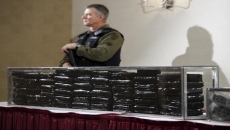
Police said they seized a semi-automatic SKS rifle, a shotgun, about 2,000 of rounds of ammunition and a knife from Raymond's apartment. They also found 22 spent casings and seven spent shotgun shells in two different rooms.
During afternoon testimony, three registered nurses from the Dr. Everett Chalmers Hospital were asked about their observations of Raymond while he was there for treatment of his gunshot wound.
Lisa Warren and Gwenda Stevenson described him as calm, sedated and co-operative during their shifts.
Heather Hannon said while doing an assessment of Raymond on Aug. 11, she asked him questions such as, where he was and why he was there.
She said he replied "I remember walking down the stairs to an ambulance" and also said, "I'm here for four murders, they tell me."
Hannon said later that day Raymond became agitated and wanted compression devices that were being used to help with his circulation removed from his legs and shackles that were restraining him loosened.
She said at one point he was shouting "There's someone in the room with me."
Hannon said when he was told there was no one else in the room, Raymond replied "I'm not crazy. Cut the bull----."
She said at that point a doctor prescribed the antipsychotic drug Haldol and he reacted well to the dosage.
The Crown has called 34 witnesses so far and will continue its case on Monday.