VICTORIA - Google Earth may soon extend it global gaze to some of the most remote First Nations territories in Canada.
Google employees will be teaching members from about 70 First Nations across the country how to chart their land on the application during a four-day Indigenous Mapping Workshop at the University of Victoria that starts Monday.
There will be two days of lectures followed by two days of hands-on training, with the goal of getting attendees to draw out their territories.
The Firelight Group, which is hosting the event, expects the maps created during the project will be private, though First Nations may upload data online if they want to make it public.
Steven DeRoy, a director with the association, said the course will allow aboriginal groups to chart multiple items on their land and compare their relationships.
He noted that interactions between wildlife, community, and water are just a few examples of the many things that can be represented on an electronic map, which he added, are also easier to use than traditional maps.
"Historically people would have had to look at paper maps and pull out another map if they wanted to see another layer and then pull out another map if they wanted to see another theme," DeRoy said. But electronic mapping technology allows people to look at several things at once.
Some First Nations are already well-versed in e-mapping, but DeRoy said many others are not due to a lack of resources and training.
Electronic mapping applications can cost thousands of dollars, making them unaffordable to many, however, the workshop hopes to make the technology more accessible by teaching people how to use Google Earth, which is free.
First Nations already using the application still have something to gain from the conference, DeRoy said, as people will also be discussing best practices.
"I think the dialogue is important," he said. "The software changes so fast that to be able to stay on top of these changing technologies can be a challenge for many nations."
The event is supported by the Union of British Columbia Indian Chiefs.
Grand Chief Stewart Phillip, president of the union, is expected to address the gathering.
"I think this conference has a lot to do with the evolution of technology," Phillip said.
The uses of e-mapping extend far beyond simply drawing borders around territories.
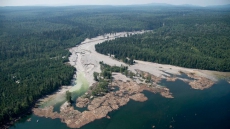
Phillip said the technology could be used to document potential environmental damage occurring on First Nations lands, and to examine the consequences of accidents such as the recent Mount Polley tailings pond spill.
"If you could develop a map showing all of the waterways that would be impacted by that spill, that would be a very graphic representation of the harm that has been inflicted on the environment," said Phillip. "I think issues like that will be discussed."
On Aug. 4, the Mount Polley tailings pond in B.C.'s Cariboo region was breached, sending millions of cubic metres of mining waste into nearby waterways, raising fears about environmental damage in the area.
Electronic mapping could also prove helpful in resolving land-claim conflicts.
"When you're discussing a land-use conflict issue, the first thing that comes out is the maps," Phillip said.
Roger William of the Tsilqhot'in First Nation said his group has been using electronic maps since 2009, and the software has been useful when holding discussions between his nation, government and businesses.
He said they provide everyone at the table with a faster way of looking at sites for proposed projects.
"It allows for a quicker flow," said William. "The government will put information on that map and we can respond."