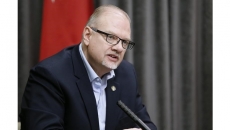
The second-in-command at the Bank of Canada said Wednesday that any changes to the underpinning of its monetary policy will be judged against how it affects the distribution of income and wealth in this country.
Senior deputy governor Carolyn Wilkins also said various frameworks the bank is reviewing are also being tested for how they fare in good economic times and bad.
The central bank is examining its monetary policy framework, looking at whether to maintain its current goal of targeting an annual inflation rate or adopt a different target in the years ahead.
Among the options under consideration include setting a dual target for the inflation and employment rates, or aiming for an average inflation rate over a longer period than one year.
Whichever is chosen will underpin central bank decisions, including setting its key interest rate that influences the rates charged for loans and mortgages.
Speaking at the start of a day-long workshop hosted by the bank, Wilkins said no one framework has emerged as a clear front-runner.
She added that no matter what the central bank chooses, its ability to smooth out sharp, sudden drops in the economy or provide sector-specific help will be limited.
"Monetary policy is ill-equipped to deal with sector-specific issues. We need to take them into account in our monetary policy decisions, but our focus must be on the macro-economy to support sustainable growth and price stability," Wilkins said, according to the prepared text of her opening remarks.
"In the current context, coming out of such a severe hit to jobs and economic activity, the bank must keep its eye on the ball."
She noted that other policies are better at handling issues the central bank can't, such as government aid, or mortgage stress-testing to limit debt risk when interest rates are low.
"All of this together highlights the challenges of policy co-ordination and the importance of central bank independence," Wilkins said in her remarks.
Next year, the central bank will renew its framework agreement with the federal government as part of a regular five-year review that has taken place since the 1990s, when it first started targeting inflation.
Work presented on Wednesday suggest the horse race is between the status quo annual inflation target of two per cent and an approach where a the bank aims to average two-per-cent over multiple years.
Jerome Powell, head of the U.S. Federal Reserve, is expected to talk about the inflation averaging method on Thursday during a talk about the future of American monetary policy. Speaking after him at the international summit of central bankers is Bank of Canada governor Tiff Macklem.
Scotiabank's Derek Holt wrote in a note Wednesday that he has "fairly low expectations for a substantial shift" from the Bank of Canada's current inflation-targeting regime.
While official measures show near-zero inflation, the perception for consumers is that prices have jumped since March. For example, meat is up by more four per cent since February, Wilkins said.
"Prices that are falling, like those around travel, are not relevant to most people, but the prices that are rising, like the cost of food, are those we encounter every week," she said.
The two per cent inflation target is considered largely arbitrary, but the bank has found it to be the ideal balance point for keeping the economy and prices stable.
If inflation starts to run high, the bank can raise its key interest rate to cool the economy. On the other hand, it can drop rates if there's a need to prod economic activity — just as it has over the past few months.
The bank slashed its key interest rate at the start of the pandemic to 0.25 per cent, which is as low as Macklem says it will go and where it will stay until the economy rebounds and inflation returns to target.
Inflation is projected to remain low this year and next, and the economy and employment not back to pre-pandemic levels potentially until 2022, based on forecasts from the federal government, the bank and private sector economists.