

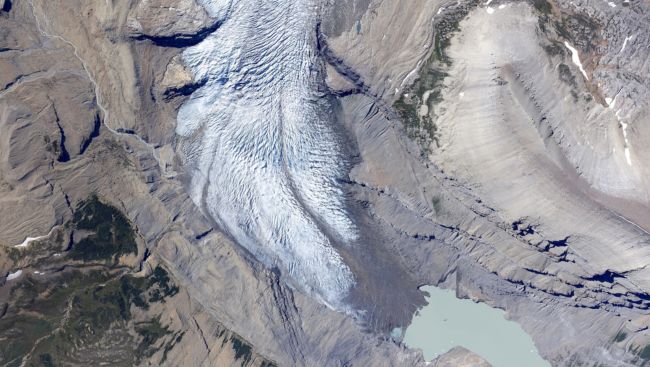
Researchers say some glaciers in Western Canada and the United States lost 12 per cent of their mass from 2021 to 2024, doubling melt rates compared to the previous decade in a continuation of a concerning global trend.
The research led by University of Northern British Columbia professor Brian Menounos says low snow accumulation over winter, early-season heat waves, and prolonged warm and dry spells were contributing factors.
It says impurities such as ash from severe wildfire seasons have also "darkened" glaciers, causing them to absorb more heat and triggering a feedback loop that will lead to continued loss unless the ice is covered by fresh snow.
The study, published in the peer-reviewed journal Geophysical Research Letters this week, examined glaciers in Western Canada and the United States, excluding Alaska and Yukon, as well as Switzerland, where glaciers lost 13 per cent of their mass over the same period.
The research letter says glaciers in both regions lost mass twice as fast as they did between 2010 and 2020.
Menounos says climate change and its effects, including heat waves and changing snow patterns, are draining the "bank account" of fresh water that glaciers contain.
"Doubling the amount of water that's lost from those glaciers, we're sort of stealing from the future," says Menounos, the Canada Research Chair in glacier change.
"We are just pulling and pulling away and making that bank account closer to zero and perhaps even negative. We're not replenishing these glaciers," he says.
The research letter published Wednesday follows a 2021 study published in the peer-reviewed journal Nature that found glaciers outside the Greenland and Antarctic ice sheets lost mass between 2010 and 2019 at double the rate they did in the first decade of this century. Menounos contributed to that study.
The latest research combined aerial surveys with ground-based observations of three glaciers in Western Canada, four glaciers in the United States and 20 in Switzerland.
The analysis shows that between 2021 and 2024, those glaciers experienced their highest rates of loss since monitoring began 60 years ago, Menounos says.
The study says that in Western Canada and the United States, black carbon doubled after about 2010, reaching the highest level of deposition in 2023 — coinciding with a severe wildfire season across B.C. and Canada.
The study did not include specific data relating to wildfire ash on each glacier, but Menounos says any darker material will absorb more heat and enhance melting.
The researchers did zero in on the Haig Glacier in the Canadian Rockies, finding the low reflectivity of the ice contributed to 17 per cent of an unprecedented loss of mass in 2022 and 2023. Summer heat had the greatest effect, responsible for 46 per cent of the loss, the letter says.
Current modelling for glaciers often doesn't include wildfire ash and other processes that could accelerate rates of loss in the future, Menounos added.
"We think that wildfire will continue to play an important role and certainly we need better physical models to project how these glaciers are likely to change."
Glaciers across the study area are projected to mostly disappear by the end of the century, even under moderate climate change scenarios. Only some of the largest glaciers and icefields are expected to exist beyond 2100, the research letter says.
Swiss glaciers represent about 55 per cent of the total volume of central European glaciers, and findings there may be applied across the Alps, the letter notes.
From 2000 to 2023, the letter says Earth's glaciers collectively lost mass at a rate of about 273 gigatonnes per year, accounting for about one-fifth of observed sea-level rise. One gigatonne represents one cubic kilometre of water, Menounos says.
"The way to perhaps bring some of the smallest glaciers back is, sometime in the future, with reduced greenhouse gas emissions," he says.
"It's a global problem, but it does require input from all countries."
Picture Courtesy: THE CANADIAN PRESS/Handout — Hakai Institute


