Politicians on both sides of the aisle have been calling on Ottawa to designate a gang tied to India as a terrorist organization.
The federal Conservatives plan to press the government on the Bishnoi gang when Parliament returns this month.
Here's a look at how the gang operates and what sets it apart from other transnational crime networks.
What is the Bishnoi gang?
Lawrence Bishnoi has been imprisoned in India for nearly a decade on charges of widespread involvement in gang violence.
In 2023, India's counterterrorism body, the National Investigation Agency, said the 32-year-old operates his "terror-syndicate from jails in different states" in India and through an associate in Canada.
Multiple Indian media outlets have reported Bishnoi sent tens of thousands of dollars in money transfers from India to both Canada and Thailand between 2019 and 2021. The Canadian Press could not verify that reporting.
"He rocketed to international fame as a criminal in quite a short period of time," said Wesley Wark, a senior fellow with the Centre for International Governance Innovation.
In an interview with The Canadian Press in 2024, Indian journalist Ritesh Lakhi, said Bishnoi took part in street fights and arsons as a student, and likely shared jail cells with notorious gang members.
Bishnoi is infamous for threatening to kill beloved Indian celebrities, political figures and business leaders. In 2022, he was accused of being behind the shooting death of Punjabi rapper Sidhu Moose Wala, who lived briefly in Canada.
How is the gang tied to India's government?
India insists that its officials have prosecuted Bishnoi for criminal acts. But the gangster is accused of orchestrating violent acts of extortion while behind bars using a cellphone, which "gives credence to the theory that the Indian state may be protecting Lawrence Bishnoi," Lakhi said.
Wark, an expert on national security and intelligence issues, said the group is widely believed "to have been used as a proxy force by the Indian government to engage in various forms of transnational repression, some violent."
What has the gang done in Canada?
In December 2023, police in Abbotsford, B.C., said they were investigating acts of extortion targeting affluent members of the South Asian community that they linked to individuals associated with the Bishnoi gang. Police in Ontario and Alberta have made similar claims.
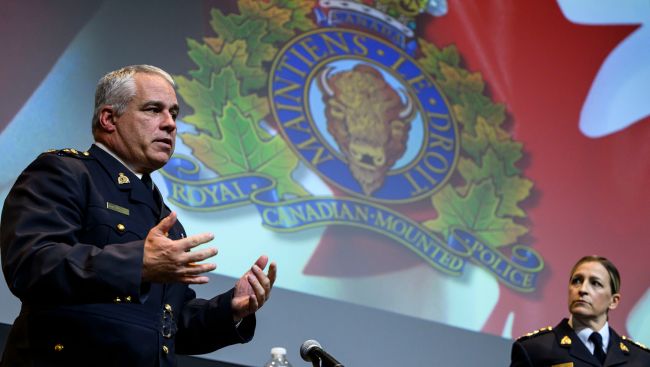
The gang rose to national prominence in Canada on Thanksgiving weekend of last year, when the RCMP accused the Bishnoi gang of orchestrating violent crimes against Sikh activists on Canadian soil.
The Mounties alleged the gang was targeting those calling for a Sikh state to be carved out of India under the name Khalistan.
They claimed Indian diplomats shared information about Khalistan supporters in Canada with officials in New Delhi, who then passed along the information to the Bishnoi gang.
RCMP Assistant Commissioner Brigitte Gauvin alleged that this arrangement led to the killing of Canadian citizens and acts of coercion and extortion.
"What we've seen, from an RCMP perspective, is the use of organized-crime elements — and it's been publicly attributed and claimed by one organized crime group in particular, which is the Bishnoi group," Gauvin said last October.
"And we believe that group is connected to agents of the government of India."
India rebutted the allegations almost immediately. Indian foreign ministry spokesman Randhir Jaiswal told a press conference that India had warned Ottawa about the Bishnoi gang.
"We find it really strange that now the people who we asked to be deported — on whom we ask that action be taken … the RCMP is blaming the Indian side that these people are committing crimes in Canada," he said.
Wark said India likely is no longer using the Bishnoi gang, with last October's bombshell press conference having "some kind of deterrent effect."
Who wants this gang named as a terror group?
B.C. Premier David Eby, a New Democrat, called for a terrorist designation in June, followed shortly after by Surrey Mayor Brenda Locke. In July Alberta Premier Danielle Smith added her voice to the calls for the designation, and federal Conservative Leader Pierre Poilievre issued his own call for it in August.
Poilievre said this would help law enforcement "shut down an international extortion network," as it would bar Canadians from raising money, recruiting or facilitating anything for the gang.
Public Safety Minister Gary Anandasangaree's office did not say whether the Liberals plan to add the Bishnoi group to the terrorism list. The government has said repeatedly it's up to public servants using objective criteria to decide which organizations get listed.
His department's spokeswoman Noémie Allard wrote that there are "explicit criteria" for a terror listing. "We do not comment on entities under review, but please note that this is an ongoing process," she wrote.
"An entity may be added if there are reasonable grounds to believe that it has knowingly carried out, attempted to carry out, participated in, or facilitated a terrorist activity — or has knowingly acted on behalf of, at the direction of, or in association with a listed terrorist entity. The decision to list an entity results from a rigorous process based on evidence, intelligence, and the law."
What are the political factors at play here?
Carleton University political scientist Jonathan Malloy said Canadian political parties have tried to walk a fine line on relations with India in order to gain support from both Sikh and Hindu voters while sidestepping tensions between those groups.
He said Canada's "complicated relationship with India" stems in part from politicians' efforts to strike that balance, through comments or policies that have upset New Delhi.
"There are a lot of calculations going on in the political parties," he said. "They're related very much to how to frame these issues for domestic, political considerations."
The federal Tories, he said, have avoided weighing in on how best to relate with India — a country Canada has flagged as both a key economic partner and a major source of foreign interference and transnational repression.
Navigating those relations has been particularly tricky since the 2023 assassination of Khalistan activist Hardeep Singh Nijjar near Vancouver. Ottawa has linked his death to the Indian government.
"The Conservatives are trying to frame this as a security issue, which plays to their emphasis on law and order," Malloy said.
What would a terror listing change?
Public Safety Canada says the Criminal Code prohibits certain actions related to listed terrorist groups, including financing, travel, and recruitment. A listed group could see its Canadian assets seized, frozen or forfeited, and banks would be required to block access to the group's accounts.
Anyone who knowingly assists the activities of listed terrorist groups could face serious criminal charges.
The federal terrorist entity list was originally limited to groups using violence to advance political goals, but has been expanded over the years to include right-wing militias, drug cartels and a branch of Iran's military.
Is a terrorist designation a good idea?
"Listing a group as a terrorist entity isn't going to have much in the way of practical application," Wark said — unless the group is moving money through Canada in a way that the authorities can disrupt.
"It's primarily a form of politics," he said. "It's security theatre."
He argues party leaders should call for a "fundamental transformation" of Canadian law enforcement, instead of "trying to suggest the government is soft on security issues."
The RCMP is struggling to perform as a national security law-enforcement agency while delivering local policing services across much of the country. The force lacks the skills and resources to adequately tackle national-security threats that have a transnational dimension, he said.
"What will be effective in stopping their activities are law-enforcement efforts and intelligence gathering," he said. "And neither of those really depend at all on listing an entity as a terrorist group."
Picture Courtesy: THE CANADIAN PRESS/Justin Tang