PETERSON AIR FORCE BASE, Colo. - American military officials have shed some light on what Canada could contribute to the missile-defence program should it choose to join after a decade spent on the sidelines.
Several conversations with high-ranking U.S. military officers point to a common desire: multi-purpose sensors in Canada's Arctic that would sniff out a wider range of potential threats than just intercontinental ballistic missiles.
Those state-of-the-art systems would be designed to track maritime vessels, airplanes and small cruise missiles — all in addition to any large missile fired off by North Korea or some hypothetical rogue state.
That means the missile-defence system that has prompted so much debate in Canada over the years could, potentially, be just one single piece integrated into the broader binational military relationship.
American military brass are aware that the missile-defence debate has been revived in Ottawa, nine years after domestic political pressure prompted the Paul Martin government to abstain.
They're weighing their public utterances carefully, wary of being seen as interfering in Canadian policy-making.
"We respectfully want them to have all the space and time to consider it now that it's been brought to the table, it seems," said U.S. Gen. Charles Jacoby, who heads Norad — the Canada-U.S. North American Aerospace Defence Command.
"If Canada decided not to belong to missile defence, then I'm sure that they would continue to play all of their robust roles that they play in missile warning and in the other Norad missions. And if they did decide (to join), I'm sure we'd take great advantage of the capabilities and commitment that Canada brings to every mission."
Since the Arctic horizon is a high-potential route for incoming missiles, so-called long-range discrimination radar — which tracks objects with greater precision than the current system — would make sense, he added.
"We're also interested in capabilities that are multi-mission, not single mission," said Jacoby, who's also commander of U.S. Northern Command, based in the same Colorado Springs facility as Norad.
"I think both countries no longer care to invest in single-mission, one-trick-pony capabilities. So we would want multi-mission kinds of sensors up there."
Canadian officials say the message has been similar in private, with the American military having made its wish-list known.
Because the missile-defence system is monitored from the same Colorado air force base that houses Norad, Canadians work alongside Americans who operate a major program to which they don't belong.
A new partnership on ballistic missile defence would "open up the door for all kinds of conversations" about deeper Canada-U.S. co-operation, said Brig.-Gen. Matt Molloy, the American general who oversees the missile-defence unit under Jacoby.
"Our polar approach, it's a vulnerability," Molloy said.
"That polar approach is of supreme importance to North American defence. And that is, I think, a great area to look at — what we can do with sensor capacity up there. There's room for capacity up there."
Japan, Australia, and several European countries have already signed on to join the missile-defence program. In Canada, a Senate committee has endorsed the idea, but the Harper government has said little.
In its early conception phase in the Reagan era, the program was known as Star Wars, a label its critics continue to use. The system includes one space-based detection satellite, several land- and sea-based sensors and rockets in California and Alaska designed to launch a 64-kg interceptor vehicle.
Bill Graham, the Liberal defence minister from a decade ago, recalls that at the time, all the U.S. government initially wanted from Canada was political support.
"It was a little bit like Iraq — they just wanted the flag," Graham said. "They wanted us to say yes. But we were not asked to put any money in, we were not at that time asked for any location for a radar-warning site."
Graham did recall one proposal to install radar in Newfoundland. The pitch came from a private company.
Nine years later, that same company — Raytheon, a Massachusetts-based defence contractor — continues to produce sensors for the program, ranging in size, capability and price tag.
Lobbying records suggest it has held meetings recently in Ottawa to discuss missile defence with at least one senator, one civil servant and, just last week, with Public Works Minister Diane Finley.
In its latest annual report, the company lays out a strategy for growth beyond the U.S. It warns that Raytheon relies on the U.S. government for 72 per cent of its sales, and needs new markets because of American budget-cutting.
Raytheon recently began building its 12th AN/TPY-2 radar for the U.S. program, at a cost of US$172.7 million. It's also one of the contractors for the more sophisticated Air Missile Defence Radar, which will cost the U.S. government US$299.9 million per unit.
One advocate for the program says Canada could possibly buy another technology, similar to the Dutch. Last week, the Netherlands announced a US$71 million plan to install radar on a frigate as part of NATO's contribution to the missile program.
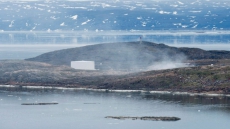
Riki Ellison of the Virginia-based Missile Defense Advocacy Alliance said Canada has a responsibility to upgrade some of its Cold War-era radar infrastructure in the Arctic, designed for big fleets of Soviet bombers. Modern risks include small, hard-to-detect rockets fired from ships, he said.
"The game's evolved," Ellison said. "There are organizations trying to get this capability that are non-state actors, that are small-state actors."