U.S. President Donald Trump's preliminary trade agreement with the United Kingdom sent a signal to countries around the world — including Canada — about the goals of his campaign to upend global trade with tariffs.
While the agreement announced Thursday has not been finalized and many details remain unclear, it suggests the president is willing to lower some tariffs but not to drop duties completely.
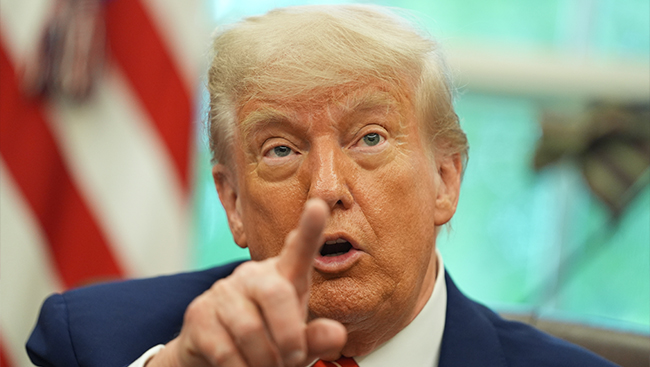
"The final details are being written up," Trump told reporters in the Oval Office.
Trump launched his trade war on the world in April with "reciprocal" tariffs, only to walk back the most devastating duties a few hours later. Trump said the 90-day pause would give countries time to negotiate a deal while he kept in place a 10 per cent universal tariff.
Trump also imposed a 145 per cent tariff on imports from China, as well as 25 per cent duties on steel, aluminum and automobiles.
The announcement Thursday was a critical one for the Trump administration as it faces mounting pressure from Americans concerned about rising prices and markets in turmoil.
Trump said the deal will boost American ethanol and beef exports to the United Kingdom. U.S. Commerce Secretary Howard Lutnick said the baseline 10 per cent tariffs on most U.K. imports to the United States will stay in place.
U.K officials said in a separate press conference that duties on steel and aluminum will be lifted, while tariffs on automobiles will drop to 10 per cent for a quota of 100,000 vehicles.
Trump's trade adviser Peter Navarro told reporters at the White House that the United Kingdom's digital services tax is "still in negotiations." The Trump administration has taken aim at Canada's own digital services tax, which it says amounts to "extraterritorial" taxation of American firms.
Experts on Canada-U.S. relations said the U.K. deal could offer hints about how Trump's administration might approach trade talks with Canada.
"It shows that the Trump administration is amenable to negotiation," said Fen Osler Hampson, an international affairs professor at Carleton University and co-chair of a group of experts on Canada-U.S. relations.
Canada was not included in Trump's "reciprocal" tariff regime and is not subject to the 90-day race to make a deal.
The president hit Canada with economywide tariffs in March, which Trump linked to the flow of fentanyl across the U.S.-Canada border. A few days later, Trump partially rescinded the duties for imports compliant under the Canada-U.S.-Mexico-Agreement on trade, called CUSMA.
Canada is also being hit with tariffs on steel, aluminum and automobiles — with a partial carveout for American-made parts of vehicles.
American Automotive Policy Council President Matt Blunt said he was disappointed that the deal Thursday would give U.K automakers an advantage over those in the deeply integrated North American auto market.
"Under this deal, it will now be cheaper to import a U.K. vehicle with very little U.S. content than a (CUSMA-compliant) vehicle from Mexico or Canada that is half American parts," Blunt said in a statement from the council, which represents the Big Three automakers — Ford, General Motors and Stellantis.
"We hope this preferential access for U.K. vehicles over North American ones does not set a precedent for future negotiations with Asian and European competitors."
CUSMA was negotiated during the first Trump administration and is up for review next year. Experts have said the president's tariffs undermine the continental trade pact.
The president's exclusion of most CUSMA-compliant imports — and his comments during an Oval Office meeting with Prime Minister Mark Carney on Tuesday — indicate Trump still sees value in the agreement. Trump said the agreement is "still very effective."
Trump's meeting with Carney was largely cordial, considering it came after months of the president taunting Canada with talk of annexation and calling former prime minister Justin Trudeau a "governor." Trump said Canada chose a "very talented person" in its election and Carney called Trump a "transformational" president.
The U.K. deal suggests the relationship reset between Carney and Trump is a very good sign, said Christopher Sands, director of Johns Hopkins University's Center for Canadian Studies.
U.K. Prime Minister Keir Starmer's "persistence and friendly professionalism were an effective combination in dealing with Trump tariffs," Sands said in a text message. A similar approach might work for Carney.
The deal with Britain indicates Trump may not want to completely blow up international trade. Sands said claims made by some Trump officials that the president is looking to reset global trade rules in the United States' favour should be taken seriously, at least for now.
The U.K. trade agreement suggests some kind of U.S. tariff on Canadian goods could remain in place, even if trade talks between Ottawa and Washington largely succeed, Hampson said.
"The reality is, we are entering an era of managed trade," he said via text message.
"If CUSMA stays in place, not only can we live with Trump's tariffs, if they are lower we may actually benefit vis-a-vis other countries who sell in the U.S. market."
Henry Olsen, a senior fellow at the Public Policy Center, poured cold water on Canadian expectations during a panel discussion at the American Enterprise Institute in Washington on Wednesday.
Trump has been clear that "he doesn't believe in trade deficits," Olsen said.
While Trump greatly exaggerates the deficit with Canada — which is linked to U.S. imports of Canadian energy — Olsen said the president will want any agreement to reduce that deficit. "That will be extremely difficult for Prime Minister Carney to do."
Picture Courtesy: THE CANADIAN PRESS/AP-Evan Vucci