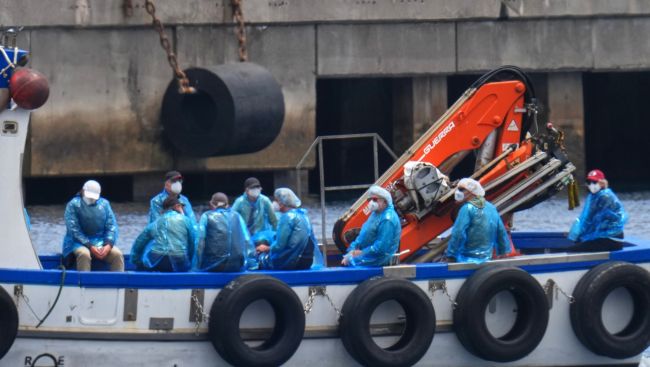
The outbreak of hantavirus on the MV Hondius cruise ship has captured the attention of Canadians and left many with questions. Here's what we know so far.
WHAT KIND OF HANTAVIRUS WAS ON THE SHIP?
Passengers on the ship got Andes virus, which is found in Argentina and Chile. It is the only type out of dozens of hantaviruses known to be capable of transmission between humans. Hantaviruses originate in rodents, including mice and rats.
HOW MANY PEOPLE HAVE RETURNED TO CANADA AND WHERE ARE THEY?
Ten people with connections to the ship's outbreak are currently located in Canada, including six passengers and four people who weren't onboard but may have been exposed to hantavirus on flights.
Four ship passengers are isolating on Vancouver Island – a couple in their 70s from the Yukon, a person in their 70s from the island, and a person from B.C. in their 50s who now lives abroad.
Dr. Bonnie Henry, British Columbia's provincial health officer, said at a news conference on Monday that their 21-day quarantine period started Sunday, but it could be extended to 42 days.
Two other passengers, who are a couple, are isolating in the Grey Bruce region of Ontario and being monitored for 45 days. One visitor to Canada was not on the ship but was on a flight with a ship passenger who later died of hantavirus. They are isolating in the Peel region of Ontario.
Two more travellers may also have been exposed to hantavirus on a flight and are isolating at home in Alberta for at least 21 days from the time of possible exposure. A Quebecer who may have been exposed on another flight was isolating up until Monday, when the province's health ministry said they were deemed a low risk contact, and could self-monitor for 42 days.
On Tuesday afternoon, Ontario's ministry of health said it asked seven more people to isolate, even though they are considered "low risk," because they had come into contact with a higher-risk person.
HOW LONG IS THE INCUBATION PERIOD?
Hantaviruses have been known to incubate for up to eight weeks but that's unusual. On average, it usually takes two to three weeks from becoming infected to showing symptoms, said Bryce Warner, a scientist specializing in hantaviruses at the Vaccine and Infectious Disease Organization at the University of Saskatchewan.
WHY ARE THERE DIFFERENT PERIODS OF QUARANTINE?
Guidance from the World Health Organization recommends a quarantine period of 42 days, or six weeks, given the hantavirus's long incubation period. But the organization has emphasized that each jurisdiction should determine the right quarantine period based on the risk level of the people who have returned, and based on whether or not they had direct contact with the passengers who became ill.
WHY CAN'T WE JUST TEST THEM FOR HANTAVIRUS?
Canada has two kinds of hantavirus tests: one that detects antibodies in the blood and a PCR test, which finds particles of the virus itself.
But because of the virus's long incubation period, experts aren't confident a test would be effective for someone who doesn't have symptoms.
None of the 10 people in Canada who were potentially exposed to the virus have exhibited symptoms, public health officials said.
"The question is always going to be, is the person truly negative because they were never actually infected with the virus, or are they negative because at the time that that one sample is collected, the virus just isn't present at high enough levels for us to find it?" said David Safronetz, chief of special pathogens at the National Microbiology Laboratory in Winnipeg.
"This is what, you know, public health agencies around the world right now are struggling with, trying to figure out what the best approach will be," he said.
As soon as someone starts showing symptoms, they will be tested, Safronetz said. Those tests would be done by provincial labs and then sent to the national lab for confirmation.
It's important to keep in mind that the illness caused by Andes virus, called hantavirus pulmonary syndrome, often starts with very general symptoms, including tiredness, a fever, or gastrointestinal symptoms.
That means even if one of the people being monitored in Canada starts to feel sick, they still may not have hantavirus.
"Hantaviruses are tricky, right? The initial presentation is often easily mistaken for something like a common cold, a headache (or) even stress," Safronetz said.
"These people are under a lot of stress right now. They've gone through quite an ordeal. And so we have to factor all of that into the testing strategies that are being put forth."
IF SOMEONE HAS HANTAVIRUS, HOW SICK DO THEY GET?
Hantavirus pulmonary syndrome tends to quickly progress to serious respiratory distress after the initial general symptoms. The mortality rate is about 30 per cent.
IS THERE TREATMENT FOR HANTAVIRUS PULMONARY SYNDROME?
There is no antiviral medication to attack the disease directly.
Treatment is mainly supportive care, including pain management, maintaining fluids and helping patients to breathe — including using a ventilator if needed, according to the World Health Organization.
HOW IS HANTAVIRUS SPREAD?
The spread of hantavirus between humans is rare, experts say.
Doctors, scientists and public health officials emphasize that close, prolonged contact — such as the conditions on a cruise ship — is needed for hantavirus to spread between humans.
"It isn't the next pandemic. I think that's the important point to remember for everybody — that this isn't COVID," Safronetz said.
Safronetz said this is a good time to be aware that there is a hantavirus in Canada called Sin Nombre virus. It has never been known to spread between humans, but a few Canadians get it each year from contact with mouse droppings.
IS THERE A VACCINE FOR HANTAVIRUS?
No.
Some scientists made a vaccine years ago in the U.S., Warner said, but it didn't go into broad clinical trials.
Some Canadian labs are working on developing hantavirus vaccines — including Warner's — but they are in the early stages of animal model testing.
"The long-term vision is, of course, you know, developing something that can be licensed and given to humans at some point. We're many years away from that," he said.
Picture Courtesy: AP Photo/Manu Fernandez