U.S. President Donald Trump's planned 25 per cent tariffs on steel and aluminum imports would be stacked on top of other levies on Canadian goods, says a White House official who confirmed the plan Tuesday on background.
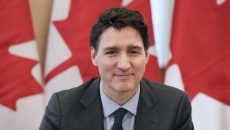
The news comes as Prime Minister Justin Trudeau cautioned U.S. Vice-President JD Vance against Trump's promised steel and aluminum levies, while Canadian premiers picked up the Team Canada mantle in Washington to push against Trump's tariff threats.
Trudeau and Vance are in Paris for a global summit on artificial intelligence. A senior government official said Trudeau spoke with the vice-president about the impact steel tariffs would have in Ohio, which Vance represented previously in the U.S. Senate.
The president signed executive orders Monday to impose 25 per cent tariffs on all steel and aluminum imports into the United States, including Canadian products, starting March 12.
Trump previously threatened 25 per cent across-the-board tariffs on Canadian imports, with a lower 10 per cent levy on Canadian energy, and says those tariffs could still proceed in early March.
Trudeau called the tariffs "unacceptable" Tuesday and said he was working with international partners to deliver a "firm and clear" response.
Tuesday's news from a White House official that these two classes of tariff would stack on top of each other would mean a total 50 per cent tariff on Canadian steel and aluminum, if those planned measures proceed.
On Monday, federal Finance Minister Dominic LeBlanc spoke with Trump's newly confirmed Treasury Secretary Scott Bessent. The "conversation focused on our common objective — building a strong North American economy that benefits citizens and industries on both sides of our shared border," LeBlanc said in a social media post.
Monday's tariff threat marks another development in Trump's larger plans to reshape global trade and American foreign policy through tariffs.
Ontario Premier Doug Ford appealed directly to American business leaders in the United States capital Tuesday, asking them to reach out to Republican lawmakers and the president himself on Canada's behalf.
"Let's stick together and please get the message to President Trump — this is not a good idea for both countries," Ford told members of the U.S. Chamber of Commerce.
This diplomatic push by the Council of the Federation, which includes all 13 provincial and territorial premiers, was planned originally as a stand against Trump's original threat of overall tariffs on Canadian imports.
Trump also moved to impose 25 per cent tariffs on all Mexican imports at the same time, but he delayed those levies for both countries until at least March 4 in response to border security commitments made separately by Canada and Mexico.
Ford said he was disappointed by the latest duties. While premiers will be talking with the federal government about retaliatory measures, Ford said it's the last thing anyone wants.
Ford, who initially suggested cutting off energy flows to the U.S., is instead leaning into his "Fortress Am-Can" proposal to deepen the resource alliance between the two countries in an effort to push back on the geopolitical influence of China.
Ford was set to meet with key Republicans Lisa McClain — chair of the House Republican Conference — Rep. Rob Wittman and Sen. Kevin Cramer later Tuesday.
British Columbia Premier David Eby, who is also in the U.S. capital, has said Canadians are "way too reliant on the decisions of one person in the White House." He said it's critical to reach out to Republicans.
Despite months of diplomacy from all levels of Canada's government, it remains unclear what Trump wants from America's northern neighbour. His initial tariff threats were linked to border security and fentanyl, but he has since widened his complaints to include defence spending and trade deficits.
Trump said Sunday that he was serious about making Canada the 51st state.
Tariffs appear inevitable, said Eric Miller, president of Rideau Potomac Strategy Group, a Washington-based cross-border consultancy focused on trade.
"I'm not sure much can change Donald Trump's mind at this point," Miller said.
Trump might waver when the stock market is affected and prices for products and energy rise, Miller said. It means there will be pain for Canada, he added, but the premiers' efforts to appeal to Republicans in Washington may blunt the impact.
"This is a case where, unfortunately, President Trump has to touch the hot stove before he realizes how valuable and integrated this relationship is," Miller said.
Ford said he believes Trump's tariff sabre-rattling is ultimately a negotiating tactic ahead of a mandatory review of the Canada-U.S.-Mexico Agreement. The trilateral pact was negotiated to replace the North American Free Trade Agreement under the first Trump administration.
During negotiations in 2018, Trump floated the idea of a 25 per cent tariff on the Canadian auto sector but it was never implemented. But he did use his national security powers to impose a 25 per cent tariff on steel and a 10 per cent tariff on aluminum imports.
Nearly a year later, Canada and Mexico were able to negotiate exemptions, which Trump removed in his Monday executive orders.
When the trade pact went into effect in 2020, Trump described it as the "best agreement we’ve ever made."
But Ford said it's now unlikely the president wants to wait for the 2026 review and Canada should be open to getting "a deal."
"The only thing certain right now in both economies is uncertainty," Ford said.