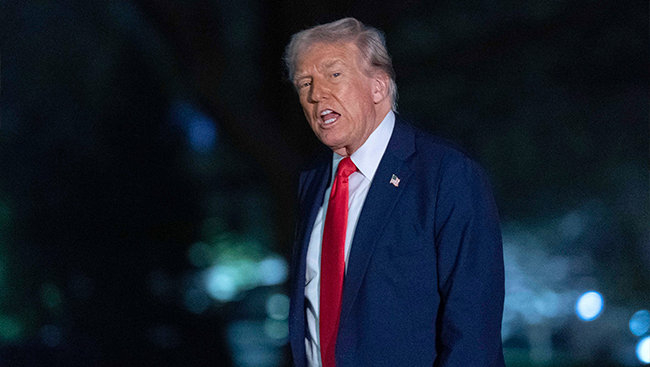
U.S. President Donald Trump on Monday provided few details of his plan this week to upend global trade through "reciprocal" tariffs as the White House confirmed there's been no decision on whether a pause on economy-wide duties against Canada will be lifted.
Trump called Wednesday "Liberation Day" — the day when he intends to impose "reciprocal" tariffs by increasing U.S. duties to match the tax rates that other countries charge on imports.
"We are going to be very nice by comparison to what they were. The numbers will be lower than what they have been charging us," Trump said in the Oval Office where he signed an unrelated executive order flanked by musician Kid Rock.
"And in some cases, maybe substantially lower, but we sort ofhave a world obligation perhaps."
White House Press Secretary Karoline Leavitt said earlier Monday there will be "no exemptions."
Canada could face an even harder hit by Trump's tariffs on Wednesday. A White House official confirmed no decision has been made on whether Trump will reinstate additional duties on Canada and Mexico, which he has linked to the flow offentanyl.
Earlier this month, Trump hit Canada and Mexico with 25 per cent across-the-board duties, with a lower 10 per cent levy on Canadian energy — then partly paused the tariffs a few days later. Trump said at the time that the pause would last until April 2.
Democrat Sen. Tim Kaine said Friday he would force a vote on Trump's use of the International Economic Emergency Powers Act, also called IEEPA, to declare an emergency at the northern border in order to hit Canada with tariffs.
In an opinion piece published in the Washington Post, Kaine wrote that "the president is using the fake emergency as a smoke screen to collect tariff revenue that he can use to fund a massive tax cut for the uber-rich."
IEEPA includes a provision allowing any senator to force a vote to block emergency powers. While it might not stop Trump's declaration of an emergency at the northern border, the vote would force Republican senators to publicly record their opinion of the measure.
U.S. government data shows the volume of fentanyl seized at the northern border is minuscule. The Annual Threat Assessment report, released last week, does not mention Canada in its section on illicit drugs and fentanyl.
Reciprocal tariffs aren't the only ones set to launch this week. Thursday will bring Trump's 25 per cent levies on automobiles.
The White House official said any carve-out for cars made with American parts under the Canada-U.S.-Mexico Agreement on trade will not be in place until there is "a system set up to gauge how much of each finished car is made with foreign components."
Earlier in March, Trump imposed 25 per cent tariffs on all steel and aluminum imports, including product from Canada.
The White House official said many of those duties would stack on top of each other if economy-wide tariffs return. Any cars or automobile parts that don't fall under the continental trade pact's rules will be hit with double duties, the official said. The White House previously said levies on steel and aluminum will jump to 50 per cent.
Canadian officials have been connecting with members ofTrump's team to gain insight into how Wednesday's duties will roll out. Ontario Premier Doug Ford spoke with U.S. Commerce Secretary Howard Lutnick last week but said he was not given any details.
"I think he has an idea, or maybe he doesn't. That's even scarier if he doesn't," Ford said last Thursday.
This week's tariff speculation comes after Trump and Prime Minister Mark Carney had their first phone conversation — which seemed to offer hope for setting the bilateral relationship on a less adversarial path.
Trump spent months repeatedly saying Canada should become a U.S. state and referring to former prime minister Justin Trudeau as a "governor."
Trump described the Friday call with Carney as "very good" and said he thinks "things are going to work out very well between Canada and the United States." Carney said the two leaders agreed to begin negotiations on a new economic and security relationship immediately after the federal election on April 28.
— With files from the Associated Press.
This report by The Canadian Press was first published March 31, 2025.