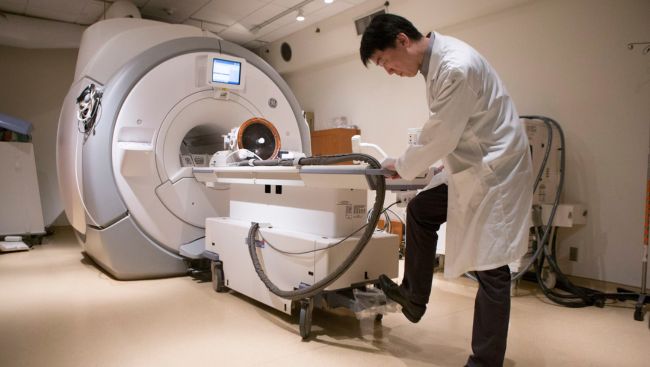
The fallout from the war in the Middle East has led to cuts in helium supplies for health services in at least one province — and experts are warning that Canada still hasn't done enough to secure sovereignty over critical medical supply chains.
Saskatchewan's health authority says it has been warned by its supplier that its "allocations" of liquid helium, used in MRI machines, "will be reduced temporarily by 50 per cent."
A spokesperson said there is no impact on patient care at this time, but researchers who rely on helium say they've been warning about supply issues for years.
"We must establish a sustainable, stable and secure helium supply in Canada," said Genevieve Seabrook, manager of the nuclear magnetic resonance research facility at Toronto's Princess Margaret Cancer Research Centre.
Strikes by Iran on Gulf states in early March led the state-owned QatarEnergy to shut down a main liquefied natural gas terminal, citing force majeure — meaning it is unable to supply its customers due to circumstances beyond its control.
Helium is a byproduct of natural gas processing and Qatar is one of the world's largest suppliers of liquid helium.
Liquid helium is used as a coolant in MRI machines and in nuclear magnetic resonance spectrometers used for scientific research.
Air Liquide, which says it is Canada's largest liquid helium distributor, has also declared force majeure and sent notices to some of its customers warning that their supply is being cut by 50 per cent and prices are being hiked.
HealthPro Canada is a non-profit company that helps around 2,100 medical facilities in Canada secure supplies. Its customers represent around 80 per cent of hospitals and health authorities in the country.
The group's president and CEO Christine Donaldson said it's pushing back against notices of price hikes.
"We have not accepted that price increase. In fact, that's where we look at all of those contracts one by one and work with our suppliers to hold them to the contract that they sign," she said.
Donaldson said there has been no impact on patients to date. She said her organization is doing a scan of its clients' needs in case the shortage continues.
"Our assessment is looking at the age of certain MRI machines and working with one of our partners to see if there's an opportunity for us to maybe target the ones that are most at risk," she said.
New MRI machines require thousands of litres of liquid helium when they're installed. Once filled, the machines only need to be replenished once or twice a year, though older machines use up their helium faster.
Seabrook helped to found the Canadian Helium Users Group, which is pushing Canada to invest in domestic helium purification and liquefaction. Right now, most helium extracted in Canadian LNG production is shipped to the U.S. to be liquefied.
Spectrometers like the kind Seabrook uses in her research require much more helium than MRI machines — her two instruments need around 500 litres every five weeks.
If they run out, she said, the magnets could "quench" — rapidly lose superconductivity — permanently damaging the machines and setting research back by years.
"It would be a catastrophe," Seabrook said.
The problem isn't new. There were helium supply issues during COVID-19 and at the start of Russia's war in Ukraine. Russia is another major supplier of helium.
Anne Snowdon is the scientific director and CEO of the Supply Chain Advancement Network in Health. Her research focuses on issues with Canada's medical supply chains.
She said the 13 health systems across the country lack the capacity to proactively plan for shortages of global supplies.
"One of the reasons is nobody owns this problem. There's no single agency in the country that is, by definition, responsible for managing and preparing for product shortages," she said.
Snowdon said there are, on average, 3,000 separate shortages in the Canadian health system each year for products ranging from IV tubing and needles to imaging contrast dyes and drugs.
The closure of the Strait of Hormuz triggered by the war has delayed shipments of active pharmaceutical ingredients — particularly from India, one of the world's biggest suppliers. These raw materials are shipped to countries like Canada to be made into medications.
A 2022 study prepared for the Canadian Generic Pharmaceutical Association found that more than 90 per cent of active pharmaceutical ingredients used in Canada are imported.
The Canadian Generic Pharmaceutical Association said in a media statement that while its members have not seen any drug shortages so far, increased costs in the supply chain are a source of concern.
The federal government committed $80.5 million in 2023 to the Canadian Critical Drug Initiative in response to drug shortages during the COVID-19 pandemic.
That funding went to Applied Pharmaceutical Innovation, an Alberta not-for-profit company that says it will soon be able to produce active pharmaceutical ingredients in Canada.
CEO Andrew MacIsaac said the thin profit margins in the generic drug industry mean his facility won't be able to replace imported ingredients — although it could step in as a short-term supplier.
"Let's say a drug manufacturer in Eastern Canada suddenly runs out of their supply from a Chinese supplier. We can step in and be their secondary site that can provide the capacity for them," he said.
Donaldson said that for now, HealthPro Canada's suppliers are required to have an inventory of three to six months' worth of those active ingredients as a buffer against any shortages.
"We have a longer runway, so that if we see any signals or any supply issues overseas, we already have the capacity to continue moving along," she said.
Snowdon said officials in all provinces should use that time to start collaborating in earnest.
"If you collaborate, then you're going to stop competing with each other. We are too small to be competing with each other and competing with the rest of the world," she said.
Picture Courtesy: THE CANADIAN PRESS/Chris Young