
Thursday, December 25, 2025
ADVT 
National

Wildfire in Peace River, B.C., quadruples in size after evacuation order

Darpan News Desk The Canadian Press, 30 May, 2025 10:54 AM
  • Wildfire in Peace River, B.C., quadruples in size after evacuation order

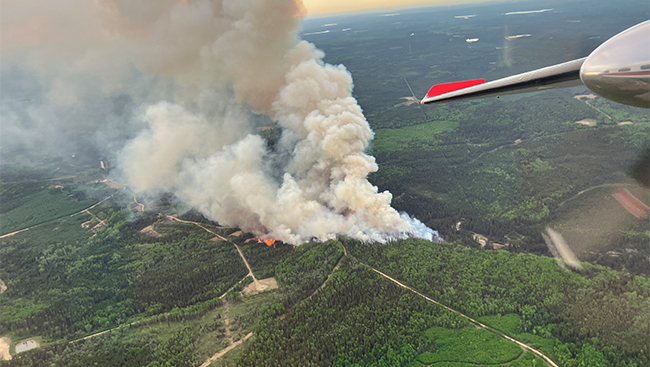
wildfire in British Columbia that prompted an evacuation order on Thursday has quadrupled in size, as firefighters prepare for "intensifying conditions" in the parched northeast of the province where most fire activity is concentrated.

The BC Wildfire Service reported that the blaze in the Peace River Regional District near the community of Kelly Lake was about 46 square kilometres in size on Friday, up from 11 square kilometres Thursday afternoon. 

The blaze was "displaying aggressive fire behaviour," the service said on social media late Thursday.

The out-of-control fire near the Alberta boundary was burning close to the Pembina Steeprock gas processing facility and Highway 52 E, also known as the Heritage Highway.

"Visibility in the area is limited due to smoke from the fire and Highway 52 has been closed in both directions," the service said.

The Peace River Regional District issued the evacuation order on Thursday afternoon for homes around Kelly Lake and areas north of Campbell Lake, west of Tent Lake, south of Twin Lakes, and east to the Alberta border.

Census data suggests Kelly Lake has a population of about 75 residents and the district said people should evacuate to Dawson Creek.

"The Dawson Creek Emergency Support Services team has stood up an emergency reception centre in response to support evacuees from the Kelly Lake community," the City of Dawson Creek said on social media, adding that it would provide food, supplies and lodging.

The fire is among about 60 burning in the province, 34 of which are classified as burning out of control.

The online dashboard of the BC Wildfire Service said the Kiskatinaw River fire was discovered on Wednesday and was believed to be human caused.

Of the active fires in B.C., the service said 18 per cent were human caused, 77 per cent were started by lightning, while five per cent have unknown causes. 

The wildfire service said in a provincial update on Friday that very high temperatures this week quickly shifted with the passage of a cold front on Thursday. That pattern could bring could bring high winds and dry lightning. 

"We have strategically positioned crews and resources in the northeast to be prepared for intensifying conditions in areas where we already have fire on the landscape," the service said.

It said increased fire behaviour was expected in June, "particularly in areas that have experienced year-over-year drought conditions, like the northeast corner of the province."

"Through Friday and the weekend, windy conditions are expected to continue with more potential for thunderstorms on Saturday and Sunday across the northern half of the province," it said.

Picture Courtesy: THE CANADIAN PRESS/HO, B.C. Wildfire Service

MORE National ARTICLES

Heiltsuk Nation written constitution passes with 67 per cent of votes

Heiltsuk Nation written constitution passes with 67 per cent of votes
The Heiltsuk Nation has approved the adoption of a written constitution for the First Nation on British Columbia's central coast. The nation says 67 per cent of the 725 people who voted on the referendum were in favour of the constitution.

Heiltsuk Nation written constitution passes with 67 per cent of votes

Poilievre's proposed incentives for First Nations water, resource projects draw fire

Poilievre's proposed incentives for First Nations water, resource projects draw fire
Conservative Leader Pierre Poilievre says he would incentivize First Nations to support natural-resource projects through industry taxes and revisiting how much sway Indigenous Peoples and environmental considerations have over approving projects.  The proposals drew swift criticism from some experts and researchers.

Poilievre's proposed incentives for First Nations water, resource projects draw fire

Indigenous kids in care more likely to experience poor health later in life: report

Indigenous kids in care more likely to experience poor health later in life: report
Indigenous people who were in government care as children experience poorer health and socioeconomic outcomes later in life than those who were never in care, a new Statistics Canada report says. They suffer higher rates of disability, lower self-rated health levels and more homelessness, and are more likely to struggle to meet basic household needs, the report says.

Indigenous kids in care more likely to experience poor health later in life: report

Ex-coroner says B.C.'s drug policy overhaul looks like 'impulsive political decision'

Ex-coroner says B.C.'s drug policy overhaul looks like 'impulsive political decision'
British Columbia's former chief coroner says she's disappointed by the province's overhaul of its program that provides prescription alternatives to toxic street drugs, a shift she says "feels like a really impulsive political decision." Lisa Lapointe said the move to a "witnessed-only" model in which people are supervised while consuming their prescription drugs appeared to ignore scientific evidence.

Ex-coroner says B.C.'s drug policy overhaul looks like 'impulsive political decision'

Internal military report blames botched shooter drill on poor organization

Internal military report blames botched shooter drill on poor organization
During the drill, which took place on Nov. 12 at a service depot at CFB Longue-Pointe in Montreal, military police also confused a racialized employee with a drill participant playing an active shooter and wrestled him to the ground.

Internal military report blames botched shooter drill on poor organization

70% of Canadians support retaliatory tariffs on United States: poll

70% of Canadians support retaliatory tariffs on United States: poll
Seventy per cent of Canadians are in favour of dollar-for-dollar retaliatory tariffs on the United States, a new poll suggests. Nearly half of respondents to the Leger poll — 45 per cent — said they were strongly in favour of such tariffs, while 25 per cent said they were somewhat in favour.

70% of Canadians support retaliatory tariffs on United States: poll