
Sunday, December 28, 2025
ADVT 
National

Wildfire in Peace River, B.C., quadruples in size after evacuation order

Darpan News Desk The Canadian Press, 30 May, 2025 10:54 AM
  • Wildfire in Peace River, B.C., quadruples in size after evacuation order

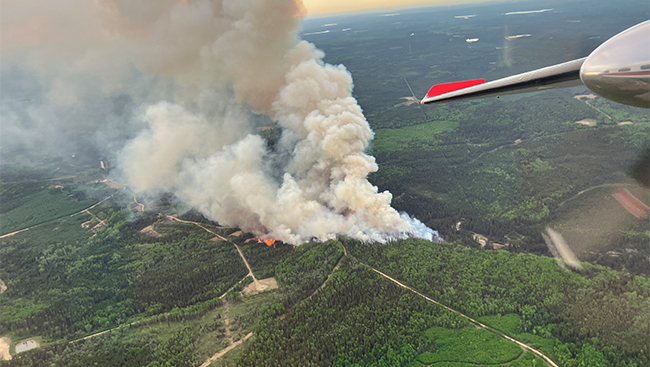
wildfire in British Columbia that prompted an evacuation order on Thursday has quadrupled in size, as firefighters prepare for "intensifying conditions" in the parched northeast of the province where most fire activity is concentrated.

The BC Wildfire Service reported that the blaze in the Peace River Regional District near the community of Kelly Lake was about 46 square kilometres in size on Friday, up from 11 square kilometres Thursday afternoon. 

The blaze was "displaying aggressive fire behaviour," the service said on social media late Thursday.

The out-of-control fire near the Alberta boundary was burning close to the Pembina Steeprock gas processing facility and Highway 52 E, also known as the Heritage Highway.

"Visibility in the area is limited due to smoke from the fire and Highway 52 has been closed in both directions," the service said.

The Peace River Regional District issued the evacuation order on Thursday afternoon for homes around Kelly Lake and areas north of Campbell Lake, west of Tent Lake, south of Twin Lakes, and east to the Alberta border.

Census data suggests Kelly Lake has a population of about 75 residents and the district said people should evacuate to Dawson Creek.

"The Dawson Creek Emergency Support Services team has stood up an emergency reception centre in response to support evacuees from the Kelly Lake community," the City of Dawson Creek said on social media, adding that it would provide food, supplies and lodging.

The fire is among about 60 burning in the province, 34 of which are classified as burning out of control.

The online dashboard of the BC Wildfire Service said the Kiskatinaw River fire was discovered on Wednesday and was believed to be human caused.

Of the active fires in B.C., the service said 18 per cent were human caused, 77 per cent were started by lightning, while five per cent have unknown causes. 

The wildfire service said in a provincial update on Friday that very high temperatures this week quickly shifted with the passage of a cold front on Thursday. That pattern could bring could bring high winds and dry lightning. 

"We have strategically positioned crews and resources in the northeast to be prepared for intensifying conditions in areas where we already have fire on the landscape," the service said.

It said increased fire behaviour was expected in June, "particularly in areas that have experienced year-over-year drought conditions, like the northeast corner of the province."

"Through Friday and the weekend, windy conditions are expected to continue with more potential for thunderstorms on Saturday and Sunday across the northern half of the province," it said.

Picture Courtesy: THE CANADIAN PRESS/HO, B.C. Wildfire Service

MORE National ARTICLES

Interprovincial trade barriers: what they are, why they exist and how to cut them

Interprovincial trade barriers: what they are, why they exist and how to cut them
The Trump administration's on-again, off-again threat to impose damaging tariffs has boosted an old idea for driving economic growth in Canada: eliminating interprovincial trade barriers. Here's a look at how interprovincial trade barriers work and why years of efforts to tear them down them have largely failed.

Interprovincial trade barriers: what they are, why they exist and how to cut them

Trudeau says U.S. tariffs on Canada will be paused for 30 days

Trudeau says U.S. tariffs on Canada will be paused for 30 days
Prime Minister Justin Trudeau says "proposed tariffs" between Canada and the United States will be paused for at least 30 days while the countries work together on the border.

Trudeau says U.S. tariffs on Canada will be paused for 30 days

Canada's forestry sector faces uncertainty with 25 per cent U.S. tariffs

Canada's forestry sector faces uncertainty with 25 per cent U.S. tariffs
A wide shadow of uncertainty has been cast over Canada's forestry sector by U.S. President Donald Trump's decision to impose a 25-per-cent tariff on its lumber products. Several industry groups have released statements criticizing the tariff as unnecessary and harmful for both sides, a sentiment echoed by British Columbia Premier David Eby who vows full support for the provincial sector.

Canada's forestry sector faces uncertainty with 25 per cent U.S. tariffs

Trump mistaken, U.S. banks can and do operate in Canada says finance professor

Trump mistaken, U.S. banks can and do operate in Canada says finance professor
A finance professor at the University of Toronto says American banks do operate in Canada despite assertions by U.S. President Donald Trump that they are not allowed to do business in the country. The Office of the Superintendent of Financial Institutions lists Amex Bank of Canada, Citibank Canada and J.P. Morgan Bank Canada on Schedule II, all having U.S. parent companies. 

Trump mistaken, U.S. banks can and do operate in Canada says finance professor

B.C. critical minerals being diverted away from United States: David Eby

B.C. critical minerals being diverted away from United States: David Eby
Companies in British Columbia are in the process of redirecting critical minerals and energy products to markets outside the United States, Premier David Eby said, as the reality of U.S. President Donald Trump's tariffs sets in. Eby noted B.C. has opened new trade offices in Taiwan, Vietnam and the Philippines over the last 18 months.

B.C. critical minerals being diverted away from United States: David Eby

Winter's first widespread snowfall hits Metro Vancouver, with more on the way

Winter's first widespread snowfall hits Metro Vancouver, with more on the way
The first widespread snowfall of winter has hit Metro Vancouver, with Environment Canada warning the ongoing wintry blast could eventually bring up to 25 centimetres to start off a frigid week. The weather agency says in a snowfall warning for the region that "intense flurries" could bring heavy accumulation and cut visibility on roads.

Winter's first widespread snowfall hits Metro Vancouver, with more on the way