

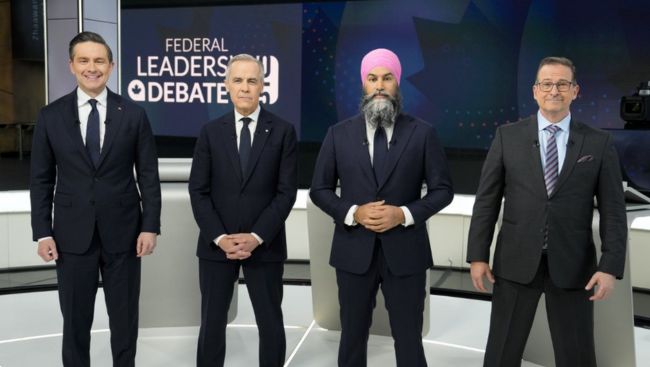
Liberal Leader Mark Carney spent his first English election debate presenting himself as a safe pair of hands for a country in crisis — while Conservative Leader Pierre Poilievre sought to frame him as more of the same after a decade of Liberal government.
Carney, who is leading in the polls, became the main target of all his rivals' attacks early in Thursday's final debate of the election — a trend that carried over from Wednesday's French language debate.
Poilievre repeatedly sought to draw a straight line from former prime minister Justin Trudeau and his policies to Carney, arguing he contributed to the “lost Liberal decade” by providing confidential advice to Trudeau on the economy.
"We need a change and you, sir, are not a change," Poilievre said in one exchange.
At another point, Poilievre called on Carney to look into the camera and apologize to people who suffered from the "inflationary policies" that he purportedly advised Trudeau to implement.
Carney contended more than once that while Poilievre might wish he was running against Trudeau, he and the former prime minister are very different people.
“You spent years running against Justin Trudeau and the carbon tax,” Carney said. “They're both gone, OK?”
Carney said he didn't provide any of the advice that Poilievre accused him of giving to Trudeau, asked to be judged on his actions and pivoted to talk about his resume — citing his time as Bank of Canada governor during the 2008 global financial crisis and at the Bank of England afterward.
"Twice, I was a central bank governor, and in both cases … when I was responsible for inflation, inflation was less than two per cent," he said. "When I was here, responsible for the Bank of Canada, inflation was less than two per cent, our dollar was at parity. That is the kind of success that I can deliver for this country coming on this crisis."
Poilievre pointed to the large number of Trudeau-era ministers, MPs and advisers on Carney's team.
"Are you prepared to elect the same Liberal MPs, the same Liberal ministers, the same Liberal staffers all over again for a fourth term? Mr. Carney, Justin Trudeau's staffers are actually here with you at this debate in Montreal, writing the talking points that you are regurgitating into the microphone," Poilievre added.
"Look, I do my own talking points, thank you very much," Carney shot back.
The Liberal leader insisted throughout the debate that the biggest threat to affordability and the economy is the "Trump crisis."
"We've got to get that right," he said.
Early in the evening, Carney said the bilateral relationship with the U.S. has "fundamentally changed" because President Donald Trump is looking to restructure the global trading system.
"The starting point has to be one of strength. It has to show that we have control of our own economic destiny, has to have a clear plan here at home to build this economy, to diversify our trading partners with like-minded countries, and also has to have a position of strength in terms of our reaction to the U.S. unjustified tariffs," Carney said.
But Poilievre claimed the Liberal government is hostile toward Canada's energy sector and pipelines. He accused the Liberals of weakening the economy and vowed that a Conservative government would repeal "anti-energy laws, red tape and high taxes."
He attacked Carney for not repealing Bill C-69, which overhauled how major national infrastructure projects are reviewed for environmental impacts.
Conservative candidates also quickly pounced on social media when Carney appeared to confuse Keystone with the Trans Mountain pipeline purchase during the debate.
The leaders of the NDP and Bloc Québécois, trailing badly in the polls, aggressively sought to assert themselves and land blows. The Green party was dropped from the debates for not running enough candidates.
NDP Leader Jagmeet Singh accused Carney of failing to defend Canadian jobs threatened by U.S. tariffs since becoming prime minister and said the Liberal government is pro-pipeline because it purchased Trans Mountain.
"I don't know what Pierre is complaining about," Singh said.
Singh spent a good portion of his time and energy attacking the Conservative leader, frequently talking over Poilievre.
He also made an appeal to voters early on, asking them not to "entrust all the power to Mr. Carney, who doesn't have a track record of making life more affordable for people." He pointed to the role his party played in bringing forward dental care and pharmacare programs in the last Parliament.
Bloc Québécois Leader Yves-François Blanchet said that while Carney claims to be different from Trudeau, he should prove that he's better than him by disclosing his financial assets — an issue that has dogged Carney throughout the campaign.
"You have to prove something, and you have to reveal what you own in those companies if you want people to believe you," Blanchet said.
Carney has refused to disclose his financial assets, leading opposition parties to accuse him of being in a potential conflict of interest through holdings from his former firm Brookfield Asset Management.
Carney has said he's put his assets in a blind trust and is following all the ethics rules for public office holders, but has refused to say anything about what his assets were before they went into the trust.
Poilievre was forced to play defence over his tough-on-crime policies and his pledge to become the first prime minister ever to use the notwithstanding clause to suspend Charter rights to put multiple murderers away for life.
"I will use the constitutional powers that are created for this purpose to ensure that mass murderers stay in maximum security penitentiary for life. They will only come out in a box," Poilievre said.
Carney countered that the Charter of Rights and Freedoms exists to "protect Canadians from people like us on the stage — politicians who may use their power to override fundamental rights."
He said the question is "not where you start, but where will you stop?"
None of the leaders got a chance to field questions from journalists in the usual post-debate Q-and-A sessions. The debate commission that organized the event abruptly cancelled the scrums following a row with the right-wing activist media organization Rebel News.
The commission did not explain why it cancelled the question sessions. Its decision came after Wednesday's debate — when right-wing media outlets dominated the post-debate scrums — and news that Rebel News had registered as an official third party in the federal election.


