The Canadian Press has been speaking with young people across the country about challenges facing their generation — and ways they continue to find joy.
'YOU'RE HUMAN AND YOU FEEL THINGS'
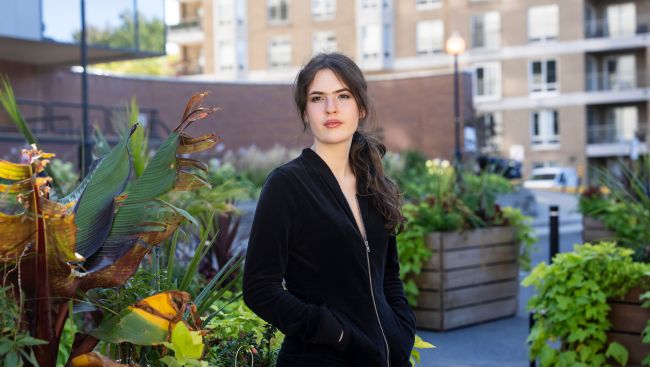
Violet Rode, an 18-year-old theatre student at Dawson College in Montreal, says she watches the anxiety and "fidgeting" of her peers and worries about the attention span of her generation.
"We do a lot of character analysis in theatre, and that's actually made me really observe why people are fidgeting with their bodies or why people are a little bit anxious," she says.
"You can tell by the way someone stands … looking around my class, and I could see everybody fidgeting and stuff, and I was like, that's attention span."
She says she's happy and optimistic but has had her own share of anxiety. She feels the COVID-19 pandemic "stunted" her generation's ability to feel comfortable around people.
"Most of the time, I would say, I'm pretty optimistic. Even when I'm sad, it's, like, OK, well you're sad for now, but then you'll be OK."
Rode says money and financial stability are a major source of stress for young Canadians. Relationships were suffering, and "unhealthy" online content was damaging young people's mental health, said Rode, who added that she didn't follow the news.
"I listen to conversations about it … but it's just always sad to me," she says, adding she prefers online content about tattoos and drag performers.
People should learn to trust their feelings more," she says.
"I'm such a sensitive, emotional person, and, like, I know that when I go against it, it makes things so hard to process and cope with."
If she feels sad, she doesn't try to "dubunk" her emotions.
"They're always valid ... because you're human and you feel things."
'I'VE JUST BEEN WORKING AND GRINDING'
Logan Ancell left Revelstoke, B.C., after high school to attend the Vancouver Institute of Media Arts but dropped out when he could no longer juggle his studies with working to pay the rent and feed himself.
Making that decision was one of the "harder points" in his life, he says, and he ended up moving back to his hometown earlier this year.
"I just was raised on, like, you leave at 18, you get a good job, you go to school, you meet somebody nice," says Ancell, 22. "But it's just like ever since I've gotten out of school, I've been just working and grinding."
After a breakup, he says, he had to work more, which meant sacrificing school time. But he still couldn't save enough money and skipped meals while relying on cheap hot dogs at the Costco food court.
"Towards the end, I was like pretty malnourished."
He says also found it hard to connect with people socially, being uninterested in casual romantic relationships and put off by a pervasive drug culture, where people he met were consistently taking hard drugs.
Ancell says his return to Revelstoke has improved his health and happiness, bringing him closer to his family, working a good restaurant job and being able to skateboard and enjoy the outdoors more.
"If I have any of those, you know, thoughts of despair, I just go fishing."
'IT'S LOOKING A LOT MORE PROMISING'
A rough economy forced Bhavik Sharma to push back his imagined life of being settled and married by 25.
He recalls how he and his friends in high school thought a six-figure salary would mean a comfortable life and starting a family by their mid-20s.
Now 27, Sharma says $100,000 a year doesn't go as far as it did a decade ago.
He moved out of his Toronto apartment in August and back in with his parents in Kitchener, Ont., after landing a better-paying job in the vicinity.
"In Toronto, it was definitely a lot harder to save for sure just because of the expenses," he says. His rent for a shared apartment was north of $1,500, combined with utilities and groceries that would eat a major chunk of his pay.
Sharma says moving back home and landing a better job has put him on track to save enough for a down payment for his first home.
"It's looking a lot more promising."
But he says he still feels the cards dealt to his generation aren't right — and that has delayed hitting goals.
"I think things could have been done definitely a lot more earlier, but just given the current economy, it has taken a little bit longer than it normally would have if you were a generation behind."
'I THINK YOU HAVE IMPOSTOR SYNDROME'
Chef and business development manager Joey Mai, 26, says like many members of Gen Z, she has to overcome feelings of anxiety and self-doubt when opportunities arise.
In her case, it was a chance to work as a marketing manager with Culinary Team Canada, which represents the nation in cooking competitions, such as the Culinary Olympics.
Mai had previously been a cooking member of the team, and everyone told her the role was a "perfect fit."
"I know marketing, I understand how hard the team works, and I was a competitor myself, so I get it."
It was a big opportunity, she says, and also "a little scary."
The professional chef, who moved to Canada from Vietnam in 2017, graduated from Red River College Polytechnic in Winnipeg. She later moved to Vancouver to study business and marketing at the British Columbia Institute of Technology.
"My friend was like, 'I think you have impostor syndrome,'' laughs Mai, who ended up getting the voluntary position.
Mai's paid job is as a business development co-ordinator with G&A Robot, a tech company that makes vending machines that serve boba tea, coffee, and snacks.
Her dream is to open a Vietnamese-Western fusion restaurant in Metro Vancouver, where she can serve her parents a meal.
It's tough to impress her mother, a dentist, and her father, a police officer, who both still live in Binh Phuoc, Vietnam, she says, as her career path isn't typical among the Asian immigrant community.
She has a message to encourage her parents to have faith in her.
"I know it's hard to believe that your daughter can do it, but thank you for believing that one day she can."
Picture Courtesy: THE CANADIAN PRESS/Handout - Logan Ancell