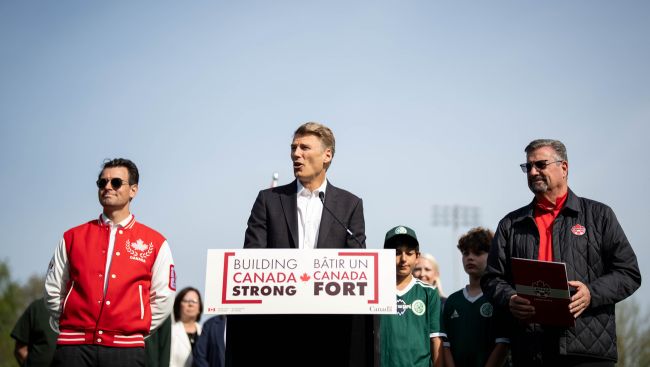
Canada Soccer's plan to build a national training centre has received a major funding boost.
The federal government announced Friday it will contribute $9.8 million from the new Build Communities Strong Fund for the planning, design and pre-construction of the proposed facility.
“The national training centre will be a multi-use, nationally significant sport and community infrastructure project, and will establish a permanent home for soccer in Canada," housing and infrastructure minister Gregor Robertson said at the announcement in Vancouver.
"The national training centre is envisioned as an integrated sport and community campus. Plans feature outdoor fields, a full-sized indoor pitch for year-round use, and high-performance training and sports science facilities.”
The funding will come from the Build Communities Strong Fund, a $51-billion infrastructure tranche included in the Liberals' 2025 budget.
Money for the training centre is part of $250 million Ottawa has earmarked for sports infrastructure across the country, said Adam van Koeverden, the country's secretary of state for sport.
The federal government also announced in its spring economic update this week that it's setting aside $660 million over the next five years for national sport organizations that have faced mounting deficits for years.
Taken together, the two pots of money represent an unprecedented dedication to Canadian sport, van Koeverden said.
“It is truly a generational investment and a landmark opportunity," he said. "It’s more than just a milestone — this is a turning point for sport in Canada.”
Canada Soccer put out a call in December, asking municipalities, provincial and territorial soccer associations, post-secondary institutions and others to come forward if they were interested in "hosting or partnering" on a future high-performance training centre.
The national sports organization received 18 submissions from across the country, said chief executive officer Kevin Blue, and is now readying to launch a formal request for proposal process in the coming weeks.
Building the new facility will give the national teams a permanent home, giving players, coaches and technical staff a place to train, prepare and compete, said Canada Soccer president Peter Augruso.
“For years, Canada has been one of the few major soccer nations in the world without a dedicated national training centre," he said. "At a time where the game is growing rapidly across every corner of this country, this gap has become impossible to ignore."
France opened its training centre in 1988, and has academies across the country, while England has St. George's Park in Staffordshire.
The Arthur M. Blank U.S. Soccer National Training Center, scheduled to open later this month in the spring in Fayetteville, Ga., includes more than a dozen soccer fields.
The funding announcement comes one day after Vancouver hosted the 76th FIFA Congress on Wednesday, and as the city prepares to host seven games during this summer's FIFA World Cup.
Toronto is also among the 16 cities across Canada, the United States and Mexico that will host the expanded 48-team tournament between June 11 and July 19.
Vancouver will stage five group-stage games, a round-of-32 matchup and a round-of-16 game. Toronto will host six matches, including Canada's first game of the tournament against Bosnia-Herzegovina on June 13.
Canada's training centre will be an important legacy of the World Cup, Augruso said.
“It’s a lasting investment in Canadian Soccer. It’s a lasting investment in Canadian communities," he said.
Ottawa plans to invest in other sports infrastructure across Canada, too.
Traditionally, the country's biggest and best facilities were built to host major events such as the Olympics or Pan American Games, said van Koeverden, an Olympic gold medallist.
The former sprint kayaker noted that he trained at the Montreal Olympic Basin, which was built for the 1976 Games. His riding in Milton, Ont., is home to a velodrome built for the PanAm Games in 2015.
“We’re stepping up to build Canadian sport infrastructure for Canadians. And that’s a real change, I have to say," he said.
"This initiative is building sport infrastructure for Canadian national teams in the absence of a large multi-sport event. Which also allows us to build it from coast to coast to coast.”
Picture Courtesy: THE CANADIAN PRESS/Ethan Cairns