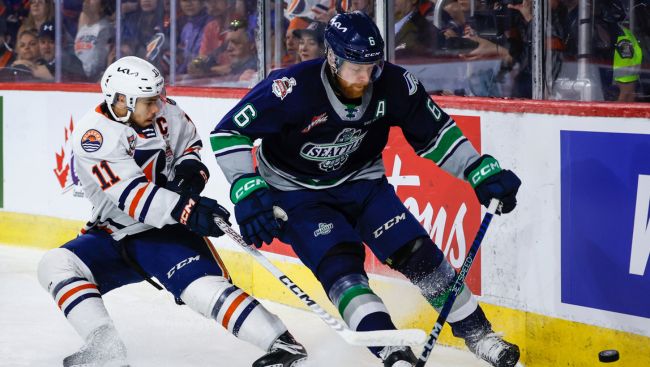
Luke Prokop came out as gay to his mother, and while Nicole Prokop embraced her son's decision she had a very specific concern.
“She was worried about my hockey career and how it might impact it,” Prokop recalled.
Pioneers such as Jason Collins (NBA) and Carl Nassib (NFL) came out as gay while they were playing. The 23-year-old Prokop in 2021 became the first player drafted and signed by an NHL team to come out, though he has yet to play in the sport's top league. Like the NHL, no active Major League Baseball player has come out while playing.
With the popularity of the show “Heated Rivalry” featuring two gay players putting a spotlight on the sport, it raised the question of how an openly gay player would be accepted in the NHL. Key stakeholders point out there are challenges but say hockey is primed for the emergence of another pioneer.
“I think people are ready for this,” said longtime league and team executive Brian Burke, whose late son Brendan came out in 2009 and made his father one of the leading advocates for LGBTQ+ access. "A player like that would be welcomed. Now, he’d face some hard right-wing criticism and social media abuse, but I think we’re ready for it.”
Why hasn't an NHL player come out?
Collins in 2013 became the first active player in one of the four North American major professional men's sports leagues to come out. Nassib in 2021 — a month before Prokop — became the first in the NFL. There are a number of openly gay players in top women's leagues, including the WNBA and PWHL.
Burke, who was executive director of the PWHL Players' Association from 2023-25, said he is surprised a player in the best men's hockey league in the world has not yet come out.
There are myriad reasons it hasn't happened yet, from concerns over the feelings of family members and teammates to the team-centric culture of hockey that discourages standing out for any reason.
“Hockey players don’t want attention and they’re going to deem it as there’s a concern that a team would see it as a distraction because of all the attention it would get,” said retired goaltender Brock McGillis, who came out after his career ended. “If you’re not a star and you’re a bubble (player), are you really going to risk that to potentially change the trajectory of your career? Maybe you get cut. Maybe you get sent down. Are you going to take that chance?”
McGillis considers men’s hockey one of, if not the most difficult, sports to come out in “because of the language, behaviors and attitudes that are pervasive in the culture.” Homophobic language is part of it.
“When I played, homophobic language was acceptable," said Burke, whose on-ice career in college and the minors came in the '70s. “It was encouraged. There’s only a handful of words you could use to say something hateful, and those were it. Referring to homosexual acts, it was commonplace, and I’m ashamed to say I was one of those guys.”
What makes the climate ready for this?
Kurt Weaver, executive director of the You Can Play nonprofit that advocates for LGBQT+ inclusion in sports, said that while homophobic language still persists in local rinks and games at many age levels, the NHL has worked with the organization and others to significantly reduce the presence of anti-gay slurs.
“There’s a massive reduction of homophobic language at the NHL level — in those locker rooms, in those organizations, in the front offices, coaches to players, players to coaches — in that environment,” Weaver said. “If you would be sitting in a locker room in 2011 when we got started and then today, it is a vastly different environment as it goes toward homophobic, racist and other hateful language."
A strong supporter of Pride and other inclusionary efforts, Scott Laughton has seen it playing more than a decade in the NHL with Philadelphia, Toronto and now Los Angeles.
“It’s changed a lot,” Laughton said. “A lot of it is language, the way you speak, and I think those (things) affect people a lot. I think it’s going in the right direction.”
Prokop's experience is an example of progress. When he came out at age 19, the Canadian said the response was “nothing but positive," at the time with Calgary of the Western Hockey League and then on six subsequent teams.
“Everywhere I’ve gone, everyone’s been open, honest, really positive,” said Prokop, who plays in the American Hockey League for the team Bakersfield, California. “Every team I’ve gone to, all the guys have been fantastic about it, and I have no reason to think that it would be any different if a player would come out in the NHL, say, tomorrow.”
Prokop was worried about how he would be perceived, and McGillis said the two spoke almost every day for months before the 6-foot-5, 220-pound defenseman decided to come out. Drafted by Nashville in the third round in 2020, the Predators' front office and coaching staff were among the people who needed to be informed. A call with them assuaged a lot of Prokop's fears.
“They said it was the right thing to do, that they wanted to help in any way they could,” Prokop said. “They thought I was really brave for doing this, and they had my back every step of the way.”
What will happen when an NHL player comes out?
Burke, 70, expects a negative outcry from people of his age range and on social media, something he said Brendan dealt with until his death in a car crash in early 2010. Then he expects an outpouring of support. He said he wished it had happened when he was general manager of an NHL team.
“It didn't happen,” Burke said. “But I think we are closer and closer to it.”
The NHL is more than a century old and change often comes slowly. There was controversy over Pride nights and even rainbow-colored tape during warmups as recently as 2023.
Commissioner Gary Bettman pointed to the league's longstanding relationship with You Can Play and teams' involvement in Pride tournaments all over North America as evidence that an openly gay player would be received positively.
“We’ve always said, and I believe it would be the case, that if a player comes out, he would be welcomed," Bettman said. “We have fully embraced being a welcoming sport on and off the ice, no matter who you are.”
Prokop said “hockey gets a bad rap” — some of it deserved — but going on his journey led him to see the best in people in the sport. McGillis believes the fan base would be welcoming and that players by and large are tolerant, based on going around talking about his experiences.
“They’re engaging with me ... and it would be easy for them not to,” McGillis said. “I’m the gay hockey dude, you know what I mean? But they are. I go into youth locker rooms across North America and in some of the most red areas of America, and it’s very progressive in terms of the way they engage with me.”
McGillis, who regrets not coming out sooner to people in his life, sees a silver lining in hockey's do-anything-for-my-teammates mentality that could eventually clear the way for a player being comfortable enough to come out.
"It might end up being one of the more supportive environments if a player did come out of any of the major team professional sports,” McGillis said. “I don’t think ‘Heated Rivalry’ is the reason for that. I think that’s always been the case.”
Picture Courtesy: Jeff McIntosh/The Canadian Press via AP, File