WATERLOO, Ont. — Canadian scientists have made an important advance that could one day lead to a science-fiction world of levitating trains and batteries that don't lose their juice sitting in the drawer.
"People might have these things in their homes — levitating devices, ultra-effecient power transmission ... these technologies exist," said David Hawthorn from the University of Waterloo in Ontario.
Hawthorn and his colleagues study superconductivity, a state in which a material exhibits zero resistance to an electric current and expels all magnetic fields. A loop of superconducting wire would be able to carry an electrical pulse around and around indefinitely with no additional energy source.
Superconductors, already used in devices such as MRI machines, could also usher in a new generation of everything from superfast computers to ultra-efficient wind turbines. But first, scientists have to crack the temperature problem.
Even a so-called "high-temperature superconductor" operates at -110 C — achievable in a lab, but not in everyday situations. A room temperature superconductor is the Holy Grail of such research.

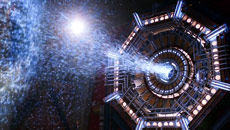
Enter Hawthorn. He used powerful, polarized X-rays generated by the synchrotron on the University of Saskatchewan campus to peer into the electrons of certain copper-containing superconducting crystals.
Those X-rays found electrons in the atoms of those crystals form patterns that may ultimately be related to how much superconductivity the crystals are capable of achieving. The patterns appear to be a key characteristic to this family of materials.
"That clearly has bearing on the big questions of superconductivity and how we might achieve a higher temperature superconductor," said Hawthorn.
"If we could figure out a way to control it in some fashion, by engineering a particular crystal or particular pressure to the material, that might give us a knob to tune the strength of superconductivity and ultimately lead to a higher temperature superconductor."
Hawthorn said the study, published in the journal Science, also suggests those electron patterns and how they form or break up could shed light on basic questions of how materials behave.
"We spend a lot of our time thinking about what would be the theory, the key ingredients that are going to describe what's happening in these materials.
"That ends up being a tremendously challenging problem and a Nobel Prize-worthy problem. If somebody was able to come up with a theory for this problem, that is a Nobel Prize."