Tuesday, December 23, 2025
ADVT 
Tech

First Chip That Uses Light For Communication Developed

IANS, 29 Dec, 2015 01:23 PM
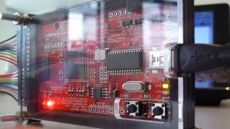
    Engineers, one of them of Indian origin, have successfully developed a single-chip microprocessor - a landmark development that opens the door to ultrafast, low-power data crunching.
     
    The researchers packed two processor cores with more than 70 million transistors and 850 photonic components onto a 3-by-6-millimetre chip.
     
    They fabricated the microprocessor in a foundry that mass-produces high-performance computer chips, proving that their design can be easily and quickly scaled up for commercial production.
     
    The new chip marks the next step in the evolution of fiber optic communication technology by integrating into a microprocessor the photonic interconnects, or inputs and outputs (I/O), needed to talk to other chips.
     
    “This is a milestone. It's the first processor that can use light to communicate with the external world,” said Vladimir Stojanovic, associate professor of electrical engineering and computer sciences at University of California-Berkeley.
     
    No other processor has the photonic I/O in the chip.
     
    Stojanovic and fellow UC Berkeley professor Krste Asanovic teamed up with Rajeev Ram at the Massachusetts Institute of Technology and Milos Popovi? at the University of Colorado, Boulder, to develop the new microprocessor.
     
    “This is the first time we've put a system together at such scale, and have it actually do something useful, like run a programme," added Asanovic.
     
    The team found the chip had a bandwidth density of 300 gigabits per second per square millimeter, about 10 to 50 times greater than packaged electrical-only microprocessors currently on the market.
     
    The photonic I/O on the chip is also energy-efficient.
     
    The achievement opens the door to a new era of bandwidth-hungry applications.
     
    One near-term application for this technology is to make data centres more green.
     
    According to the US Natural Resources Defense Council, data centres consumed about 91 billion kilowatt-hours of electricity in 2013 - about two percent of the total electricity consumed in the US.
     
    The paper was published in the journal Nature.
    MORE Tech ARTICLES

    Hubble telescope inspired tech helps restore eyesight

    Hubble telescope inspired tech helps restore eyesight
    NASA's telescopes are not just helping us look into the dark deep universe but have inspired surgeons to restore the eyesight of the elderly....

    Hubble telescope inspired tech helps restore eyesight

    How does nature's strongest glue stick?

    How does nature's strongest glue stick?
    Barnacles produce the strongest glue or cement found in nature. The material is better than anything we have developed synthetically and sticks to any surface, even underwater...

    How does nature's strongest glue stick?

    Oceans vital for alien life on other planets

    Oceans vital for alien life on other planets
    Oceans have an immense capacity to control climate and they are vital in sustaining life even in case there is any on other planets, says a study....

    Oceans vital for alien life on other planets

    Sniffer laser for hard-to-detect explosives

    Sniffer laser for hard-to-detect explosives
    There's bad news for bomb-sniffing dogs: researchers have found a way to increase the sensitivity of a light-based sensor to detect incredibly minute amounts of explosives....

    Sniffer laser for hard-to-detect explosives

    NASA celebrates 45 years of moon landing

    NASA celebrates 45 years of moon landing
    On July 20, 1969, Apollo 11 astronauts Neil Armstrong and Buzz Aldrin became the first humans to set foot on the moon....

    NASA celebrates 45 years of moon landing

    New technology to make nuclear waste clean-up cheaper

    New technology to make nuclear waste clean-up cheaper
    In what could solve the commercial problems associated with clean-up of nuclear waste, researchers have successfully tested a material that can extract...

    New technology to make nuclear waste clean-up cheaper