Sunday, December 21, 2025
ADVT 
Tech

'Google street view' of galaxies a reality

Darpan News Desk IANS, 24 Jul, 2014 08:09 AM
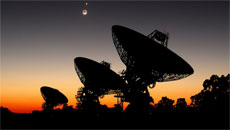
    Australian astronomers have developed a home-grown instrument based on bundles of optical fibres that gives the first 'Google street view' of the cosmos.
     
    Developed by researchers at University of Sydney and Australian Astronomical Observatory, the optical-fibre instrument called SAMI can sample the light from up to 60 parts of a galaxy for a dozen galaxies at a time.
     
    By analysing the light's spectrum astronomers can learn how gas and stars move within each galaxy, where the young stars are forming and where the old stars live.
     
    Using the new instrument, astronomers have already spotted "galactic winds" - "streams of charged particles travelling at up to 3,000 km a second - from the centre of two galaxies.
     
    "It is a giant step. Before this, we could study one galaxy at a time in detail or lots of galaxies at once but in much less detail. Now we have both the numbers and the detail," explained James Allen of the ARC Centre of Excellence for All-sky Astrophysics (CAASTRO) at University of Sydney.
     
    In just 64 nights, the team has gathered data on 1,000 galaxies and over the next two years, it will study another 2,000.
     
    The optical-fibre instrument was installed on the 4-m Anglo-Australian Telescope at Siding Spring Observatory in northwest New South Wales, Australia last year.
     
    The researchers are also uncovering the formation history of galaxies by looking to see if they are rotating in a regular way or if the movement of their stars is random and disordered.
     
    "There are hints that galaxies with random motions sit at the centres of groups of galaxies, where many smaller galaxies may have fallen into them," informed Dr Lisa Fogarty, a CAASTRO researcher at University of Sydney.

    MORE Tech ARTICLES

    Revealed: How Earth gets protection from space weather

    Revealed: How Earth gets protection from space weather
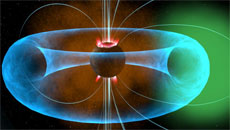
    The NASA scientists have discovered how dense particles near earth can send a plume up through space to help protect against incoming solar particles during certain space weather events.

    Revealed: How Earth gets protection from space weather

    Dream about a space trip? Click Here

    Dream about a space trip? Click Here
    Have an extra Rs.1.25 crore in your kitty? You can book a seat on a European plane that would take passengers to over 100 km in the sky -- enabling them to experience how being in space feels.

    Dream about a space trip? Click Here

    A giant leap towards discovering life beyond earth

    A giant leap towards discovering life beyond earth
    In what could be called a game changer in search of life outside our galaxy, astronomers have used a digital camera imaging technology to take a picture of a planet far from our solar system with an earth-based telescope.

    A giant leap towards discovering life beyond earth

    Sugar to Power Smart Phones for 10 days!

    Sugar to Power Smart Phones for 10 days!
    A bio-battery converts sugar into energy - much like our metabolism - decomposing sugar into carbon dioxide and water while releasing electrons.

    Sugar to Power Smart Phones for 10 days!

    WhatsApp founders in Forbes' global billionaires list

    WhatsApp founders in Forbes' global billionaires list
    Following Facebook's $19 billion acquisition of WhatsApp, the two founders of the popular mobile messaging service have now earned a new distinction - a place in the Forbes's list of global billionaires.

    WhatsApp founders in Forbes' global billionaires list

    Ancient virus revival poses threat to humans

    Ancient virus revival poses threat to humans
    A 30,000-year-old giant virus frozen in ice has been revived owing to global warming. Scientists now warn that melting ice around the world could uncover new biological threats to human or animal health

    Ancient virus revival poses threat to humans