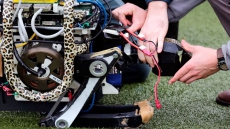
A team led by an Indian-origin computer engineer from University of Washington has built a five-fingered robotic hand that can not only perform dexterous in-hand manipulation but also learn from its own experience without depending on humans to direct it.
Hand manipulation is one of the hardest problems that roboticists have to solve.
“Several robots today have pretty capable arms but the hand is as simple as a suction cup or maybe a claw or a gripper,” said lead author Vikash Kumar, doctoral student in computer science and engineering.
The team spent years custom building one of the most highly capable five-fingered robot hands in the world.
Then they developed an accurate simulation model that enables a computer to analyse movements in real time.
In their latest demonstration, they apply the model to the hardware and real-world tasks like rotating an elongated object.
With each attempt, the robot hand gets progressively more adept at spinning the tube, thanks to machine learning algorithms that help it model both the basic physics involved and plan which actions it should take to achieve the desired result.
“What we are using is a universal approach that enables the robot to learn from its own movements and requires no tweaking from us, added senior author and lab director Emo Todorov.
Building a dexterous, five-fingered robot hand poses challenges, both in design and control.
The dexterous robot hand -- which the team built at a cost of roughly $300,000 -- uses a “Shadow Hand” skeleton actuated with a custom pneumatic system and can move faster than a human hand.
It is too expensive for routine commercial or industrial use but it allows the researchers to push core technologies and test innovative control strategies.
The team developed algorithms that allowed a computer to model highly complex five-fingered behaviours and plan movements to achieve different outcomes -- like typing on a keyboard or dropping and catching a stick -- in simulation.
Most recently, the research team has transferred the models to work on the actual five-fingered hand hardware, which never proves to be exactly the same as a simulated scenario.
As the robot hand performs different tasks, the system collects data from various sensors and motion capture cameras and employs machine learning algorithms to continually refine and develop more realistic models.

"It's like sitting through a lesson, going home and doing your homework to understand things better and then coming back to school a little more intelligent the next day," Kumar noted in a paper to be presented at the IEEE International Conference on Robotics and Automation in Stockholm on May 17.