Friday, December 26, 2025
ADVT 
Tech

Indian-Origin Scientist's Robot's In-Hand Eye Maps Surroundings, Determines Hand's Location

Darpan News Desk IANS, 17 May, 2016 10:59 AM
    Researchers including an Indian-origin scientist from Carnegie Mellon University have found that a camera attached to the robot's hand can rapidly create a 3D model of its environment and also locate the hand within that 3D world.
     
    The team found they can improve the accuracy of the map by incorporating the arm itself as a sensor, using the angle of its joints to better determine the pose of the camera.
     
    This will be important for a number of applications including inspection tasks.
     
    “Placing a camera or other sensor in the hand of a robot has become feasible as sensors have grown smaller and more power-efficient,” said Siddhartha Srinivasa, associate professor of robotics.
     
    That is important because robots "usually have heads that consist of a stick with a camera on it”.
     
    They can't bend over like a person could to get a better view of a work space.
     
    But an eye in the hand isn't much good if the robot can't see its hand and doesn't know where its hand is relative to objects in its environment.
     
    It's a problem shared with mobile robots that must operate in an unknown environment.
     
    A popular solution for mobile robots is called simultaneous localization and mapping (SLAM) in which, the robot pieces together input from sensors such as cameras, laser radars and wheel odometry to create a 3D map of the new environment.
     
    "There are several algorithms available to build these detailed worlds, but they require accurate sensors and a ridiculous amount of computation," Srinivasa noted.
     
    The researchers demonstrated their Articulated Robot Motion for SLAM (ARM-SLAM) using a small depth camera attached to a lightweight manipulator arm - the Kinova Mico.
     
    In using it to build a 3-D model of a bookshelf, they found that it produced reconstructions equivalent or better to other mapping techniques.
     
    “We still have much to do to improve this approach, but we believe it has huge potential for robot manipulation," Srinivasa pointed out.
     
    The researchers presented their findings at the IEEE International Conference on Robotics and Automation in Stockholm, Sweden on Tuesday.
    MORE Tech ARTICLES

    Automated cockpits may drive pilots crazy!

    Automated cockpits may drive pilots crazy!
    Automation in the cockpits are designed to free pilots from paying attention to the mundane flight tasks and allow them to concentrate on the overall flight, but they can also drive the pilots crazy, indicated a study.

    Automated cockpits may drive pilots crazy!

    Soon, Boeing spacecraft to send astronauts in space

    Soon, Boeing spacecraft to send astronauts in space
    Leveraging its expertise in the space-bound flight operations, Boeing has unveiled a concept of a manned spaceflight that is expected to send astronauts into space by 2017.

    Soon, Boeing spacecraft to send astronauts in space

    Britain's oldest town unearthed

    Britain's oldest town unearthed
    Until now, Thatcham in Buckinghamshire was known as the oldest settlement in Britain but now, archaeologists have unearthed the country's oldest town that dates back more than 10 millennia to 8,820 BC.

    Britain's oldest town unearthed

    Coming, money transfer via Google Glass!

    Coming, money transfer via Google Glass!
    With Google Glass eyewear, soon send money to your friends and relatives in a jiffy.

    Coming, money transfer via Google Glass!

    And now diamonds to power laser!

    And now diamonds to power laser!
    Diamonds are not just a woman's best friend, they also have some awesome heat-handling capability - making it an ideal material to improve the quality of high-powered laser beams.

    And now diamonds to power laser!

    Latest in Tech: Fold this smart phone like a map!

    Latest in Tech: Fold this smart phone like a map!
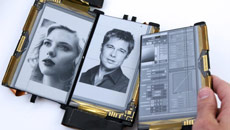
    Named “multi-display shape-changing smartphone”, the 'PaperFold' mobile device uses three flexible electrophoretic (e-ink) display sheets that users can fold into various configurations.  

    Latest in Tech: Fold this smart phone like a map!