Saturday, December 27, 2025
ADVT 
Tech

Indian-Origin Scientist's Robot's In-Hand Eye Maps Surroundings, Determines Hand's Location

Darpan News Desk IANS, 17 May, 2016 10:59 AM
    Researchers including an Indian-origin scientist from Carnegie Mellon University have found that a camera attached to the robot's hand can rapidly create a 3D model of its environment and also locate the hand within that 3D world.
     
    The team found they can improve the accuracy of the map by incorporating the arm itself as a sensor, using the angle of its joints to better determine the pose of the camera.
     
    This will be important for a number of applications including inspection tasks.
     
    “Placing a camera or other sensor in the hand of a robot has become feasible as sensors have grown smaller and more power-efficient,” said Siddhartha Srinivasa, associate professor of robotics.
     
    That is important because robots "usually have heads that consist of a stick with a camera on it”.
     
    They can't bend over like a person could to get a better view of a work space.
     
    But an eye in the hand isn't much good if the robot can't see its hand and doesn't know where its hand is relative to objects in its environment.
     
    It's a problem shared with mobile robots that must operate in an unknown environment.
     
    A popular solution for mobile robots is called simultaneous localization and mapping (SLAM) in which, the robot pieces together input from sensors such as cameras, laser radars and wheel odometry to create a 3D map of the new environment.
     
    "There are several algorithms available to build these detailed worlds, but they require accurate sensors and a ridiculous amount of computation," Srinivasa noted.
     
    The researchers demonstrated their Articulated Robot Motion for SLAM (ARM-SLAM) using a small depth camera attached to a lightweight manipulator arm - the Kinova Mico.
     
    In using it to build a 3-D model of a bookshelf, they found that it produced reconstructions equivalent or better to other mapping techniques.
     
    “We still have much to do to improve this approach, but we believe it has huge potential for robot manipulation," Srinivasa pointed out.
     
    The researchers presented their findings at the IEEE International Conference on Robotics and Automation in Stockholm, Sweden on Tuesday.
    MORE Tech ARTICLES

    3D-printed replica for a safe liver transplant created

    3D-printed replica for a safe liver transplant created
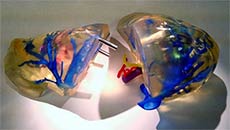
    The 3D-printed liver replicas, made of transparent material threaded with coloured arteries and veins, could help surgeons prevent complications while performing liver transplants or removing tumours, a path-breaking research shows.

    3D-printed replica for a safe liver transplant created

    First Look: World's first winemaker machine for your kitchen!

    First Look: World's first winemaker machine for your kitchen!
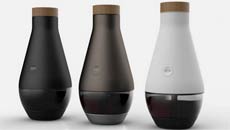
    Three cheers for wine lovers out there. Here comes a new machine that can turn water, grape concentrate, yeast and a finishing powder into wine in your kitchen in flat three days.

    First Look: World's first winemaker machine for your kitchen!

    Who is smarter, man or woman? It's just a brain, stupid!

    Who is smarter, man or woman? It's just a brain, stupid!
    The big debate about who is smarter, man or woman, has now been laid to rest. There is nothing like a boy's or a girl's brain, and no scientific evidence to prove that they are wired differently, according to an expert.

    Who is smarter, man or woman? It's just a brain, stupid!

    Samsung wearable device to turn hands into keyboard

    Samsung wearable device to turn hands into keyboard
    As the race for wearable computer devices heats up with the entry of Google Glass, a report suggests that Samsung is also working on a wearable device that can turn hands into a virtual keyboard.

    Samsung wearable device to turn hands into keyboard

    Indian-origin engineers create device for faster wireless technology

    Indian-origin engineers create device for faster wireless technology
    Using an inexpensive Rs.3,600 inkjet printer, two Indian-origin electrical engineers at the University of Utah have for the first time produced microscopic structures that use light in metals to carry information

    Indian-origin engineers create device for faster wireless technology

    China Logs on to its First Internet-Themed Museum

    China Logs on to its First Internet-Themed Museum
    China will build its first internet museum to chronicle the development of the net in the increasingly wired country, China's internet network watchdog said Friday.

    China Logs on to its First Internet-Themed Museum