Thursday, December 25, 2025
ADVT 
Tech

Indian-Origin Scientist's Robot's In-Hand Eye Maps Surroundings, Determines Hand's Location

Darpan News Desk IANS, 17 May, 2016 10:59 AM
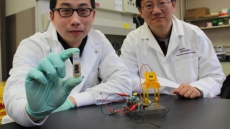
    Researchers including an Indian-origin scientist from Carnegie Mellon University have found that a camera attached to the robot's hand can rapidly create a 3D model of its environment and also locate the hand within that 3D world.
     
    The team found they can improve the accuracy of the map by incorporating the arm itself as a sensor, using the angle of its joints to better determine the pose of the camera.
     
    This will be important for a number of applications including inspection tasks.
     
    “Placing a camera or other sensor in the hand of a robot has become feasible as sensors have grown smaller and more power-efficient,” said Siddhartha Srinivasa, associate professor of robotics.
     
    That is important because robots "usually have heads that consist of a stick with a camera on it”.
     
    They can't bend over like a person could to get a better view of a work space.
     
    But an eye in the hand isn't much good if the robot can't see its hand and doesn't know where its hand is relative to objects in its environment.
     
    It's a problem shared with mobile robots that must operate in an unknown environment.
     
    A popular solution for mobile robots is called simultaneous localization and mapping (SLAM) in which, the robot pieces together input from sensors such as cameras, laser radars and wheel odometry to create a 3D map of the new environment.
     
    "There are several algorithms available to build these detailed worlds, but they require accurate sensors and a ridiculous amount of computation," Srinivasa noted.
     
    The researchers demonstrated their Articulated Robot Motion for SLAM (ARM-SLAM) using a small depth camera attached to a lightweight manipulator arm - the Kinova Mico.
     
    In using it to build a 3-D model of a bookshelf, they found that it produced reconstructions equivalent or better to other mapping techniques.
     
    “We still have much to do to improve this approach, but we believe it has huge potential for robot manipulation," Srinivasa pointed out.
     
    The researchers presented their findings at the IEEE International Conference on Robotics and Automation in Stockholm, Sweden on Tuesday.
    MORE Tech ARTICLES

    Google Glass app that reads emotions, also reveals age

    Google Glass app that reads emotions, also reveals age
    What if an app can reveal what the person you are in a conversation with is thinking? This Google Glass - a soon to be launched smart eye-wear - app...

    Google Glass app that reads emotions, also reveals age

    Soon batteries to run on sugar

    Soon batteries to run on sugar
    In a breakthrough to develop long-lasting batteries for smartphones and other gadgets, scientists have successfully created a sugar biobattery that...

    Soon batteries to run on sugar

    App to help deal with emergency heart conditions

    App to help deal with emergency heart conditions
    Taking the right decision in a matter of seconds is crucial when dealing with heart attacks or acute heart diseases. The process will become a lot easier with the help of a new app....

    App to help deal with emergency heart conditions

    Don't rely on YouTube videos to save lives

    Don't rely on YouTube videos to save lives
    YouTube is full of videos depicting life saving techniques like Cardio-pulmonary Resuscitation (CPR) and Basic Life Support (BLS) but only a handful of these...

    Don't rely on YouTube videos to save lives

    New tool maps how drug abuse affects brain

    New tool maps how drug abuse affects brain
    The new technology may aid in improving brain-cancer surgery and tissue engineering, and lead to better treatment options for recovering drug addicts...

    New tool maps how drug abuse affects brain

    How movement affects hearing

    How movement affects hearing
    Ever wondered why we stop moving when we carefully want to listen to someone? This, scientists have found, is not just to prevent unwanted sounds generated...

    How movement affects hearing