Friday, December 19, 2025
ADVT 
Tech

Journal defends Facebook 'emotion contagion' study

Darpan News Desk IANS, 04 Jul, 2014 11:48 AM
    A scientific journal that published the Facebook study about how emotions spread across social networks has defended its decision to publish the research.
     
    According to Inder Verma, editor-in-chief of the Proceedings of the National Academy of Sciences, the decision to publish the research was deemed appropriate based on the information provided by the study authors.
     
    "Obtaining informed consent and allowing participants to opt out are best practices in most instances under the US Department of Health and Human Services Policy for the Protection of Human Research Subjects," Verma said in a statement.
     
    "As a private company, Facebook was under no obligation to conform to the provisions of the Common Rule when it collected the data used by the authors, and the Common Rule does not preclude their use of the data," Verma wrote.
     
    It is nevertheless a matter of concern that the collection of the data by Facebook may have involved practices that were not fully consistent with the principles of obtaining informed consent and allowing participants to opt out, Verma emphasised in the note.
     
    The study was conducted by Facebook researchers on nearly 700,000 users to investigate a phenomenon dubbed "emotional contagion".
     
    The researchers found that emotional states can spread across social networks.
     
    The research has sparked uproar among people who felt the study violated personal privacy.

    MORE Tech ARTICLES

    Incredible! Earth goes red for better health!

    Incredible! Earth goes red for better health!
    Taken by NASA's MErcury Surface, Space ENvironment, GEochemistry, and Ranging (MESSENGER) spacecraft, it shows fertile areas from South America 

    Incredible! Earth goes red for better health!

    Here's an iPhone app that paints your photos into masterpieces

    Here's an iPhone app that paints your photos into masterpieces
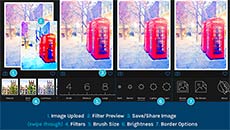
    The app now simulates the spreading and bleeding of the pigment onto the canvas - with dedicated properties for the virtual paper, the pigment, the brushes, the water and so on

    Here's an iPhone app that paints your photos into masterpieces

    3D-printed replica for a safe liver transplant created

    3D-printed replica for a safe liver transplant created
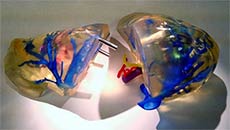
    The 3D-printed liver replicas, made of transparent material threaded with coloured arteries and veins, could help surgeons prevent complications while performing liver transplants or removing tumours, a path-breaking research shows.

    3D-printed replica for a safe liver transplant created

    First Look: World's first winemaker machine for your kitchen!

    First Look: World's first winemaker machine for your kitchen!
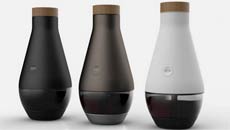
    Three cheers for wine lovers out there. Here comes a new machine that can turn water, grape concentrate, yeast and a finishing powder into wine in your kitchen in flat three days.

    First Look: World's first winemaker machine for your kitchen!

    Who is smarter, man or woman? It's just a brain, stupid!

    Who is smarter, man or woman? It's just a brain, stupid!
    The big debate about who is smarter, man or woman, has now been laid to rest. There is nothing like a boy's or a girl's brain, and no scientific evidence to prove that they are wired differently, according to an expert.

    Who is smarter, man or woman? It's just a brain, stupid!

    Samsung wearable device to turn hands into keyboard

    Samsung wearable device to turn hands into keyboard
    As the race for wearable computer devices heats up with the entry of Google Glass, a report suggests that Samsung is also working on a wearable device that can turn hands into a virtual keyboard.

    Samsung wearable device to turn hands into keyboard