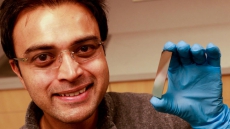
A University of Calgary researcher says key cards, lanyards with sensors and wrist devices similar to Fitbits could help make schools and workplaces safer as people adjust to living with the novel coronavirus.
"Just as 9/11 changed our airports forever, COVID-19 is going to change how we design our public spaces and how we live, work and play," said Steven Liang, an associate professor in the Department of Geomatics Engineering at the university's Schulich School of Engineering.
Liang has been named to the Rogers Internet of Things Chair, which is meant to advance innovative tech solutions to support Canadian businesses.
He is focusing on energy, smart cities, transportation, and workplace safety, including COVID-19-related solutions.
"In future we need to know the risk levels for workplaces and workforces so that we can feel comfortable to go back to work — because life has to continue," Liang said in an interview with The Canadian Press.
"The proper use of technology allows us to have additional protection and also allows decision-makers to say, 'OK, how can I justify my decisions? How soon should I bring my workforces back?'"
Liang believes digital sensors carried by staff or students may prove to be a way for employers and institutions to protect their people in a pandemic-sensitive world.
"It could be a button or a wristband. Wearables are something organizations or corporations could issue to their people, to monitor health and safety," said Liang.
"Like a laptop or identification card, it just becomes part of the gear you carry around at work."
Liang said sensors could be mounted on walls to identify overcrowding in hallways or in rooms to indicate when cleaning was necessary. Biosensors could be used to check temperatures and heart rates to prevent potentially ill people from coming inside and spreading the virus.
"My focus is not just the sensor, which is people-to-people interaction, but on people-to-place interactions as well," he said.
"The system would generate a risk profile for both people and places within the corporation, so you could track clusters and patterns, or identify a room that needs to be disinfected immediately."
Liang said the approach would help negate privacy concerns from people not wanting to be tracked through their cellphones.
He said not all workers would need to carry sensors, but added they could be useful to protect individuals working alone. Employers would know where their employees were and what conditions they were in.
Liang has a similar system already in place with Vancouver Fire Rescue Service, where trackers have been introduced to improve worker safety.
"There's a digital map where you can see where the firefighters are and what's their heart rate and their exposure to heat and gas."
Liang expects to produce a prototype within a couple of months that will be able to be studied to determine its possible applications in emerging challenges.