Saturday, December 20, 2025
ADVT 
Tech

Sniffer laser for hard-to-detect explosives

Darpan News Desk IANS, 21 Jul, 2014 07:26 AM
    There's bad news for bomb-sniffing dogs: researchers have found a way to increase the sensitivity of a light-based sensor to detect incredibly minute amounts of explosives.
     
    The tiny laser sensor can even sniff out a hard-to-detect explosive called pentaerythritol tetranitrate (PETN), a favourite among terrorists.
     
    Small amounts of PETN pack a powerful punch and being a plastic, it escapes x-ray machines when not connected to detonators.
     
    PETN was found in Richard Reid's shoe bomb in 2001 and Umar Farouk Abdulmtallab's underwear bomb in 2009.
     
    “The ability to magnify a small trace of an explosive to create a detectable signal is a major development in plasmon sensor technology,” said lead researcher Xiang Zhang, a professor of mechanical engineering at University of California Berkeley.
     
    During trials, the laser sensor device successfully detected very low concentration of various explosives, including dinitrotoluene (DNT), ammonium nitrate and nitrobenzene.
     
    According to the study, the new sensor could have many advantages over current bomb-screening methods.
     
    Bomb-sniffing dogs are expensive to train and they get tired.
     
    Swabs, commonly used at airports to detect explosive residue, have relatively low-sensitivity and involve physical contact.
     
    "Our technology could lead to a bomb-detecting chip for a handheld device that can detect the tiny-trace vapour in the air of the explosive's small molecules,” informed co-author Ren-Min Ma, an assistant professor of physics at Peking University in China.
     
    The sensor could also be developed into an alarm for unexploded land mines that are otherwise difficult to detect, the researchers said.
     
    The nanoscale plasmon sensor used in the lab experiments is much smaller than other explosive detectors on the market.
     
    Zhang said the new sensor creates a much stronger signal than the passive plasmon sensors currently available, which work by detecting shifts in the wavelength of light.
     
    The findings were published in journal Nature Nanotechnology.

    MORE Tech ARTICLES

    Watch out! Cell phone addiction may kill parent-child bond

    Watch out! Cell phone addiction may kill parent-child bond
    Do you often play games, check emails or respond to office calls on your cell phone while with family on a dinner? This phone addiction can damage your emotional bonding with kids soon.

    Watch out! Cell phone addiction may kill parent-child bond

    What? Plant-powered FM radio is here

    What? Plant-powered FM radio is here
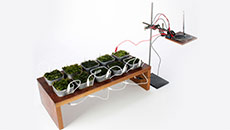
    Named Moss FM, the radio is designed by University of Cambridge biochemist Paolo Bombelli and London-based product designer Fabienne Felder.

    What? Plant-powered FM radio is here

    Incredible! Earth goes red for better health!

    Incredible! Earth goes red for better health!
    Taken by NASA's MErcury Surface, Space ENvironment, GEochemistry, and Ranging (MESSENGER) spacecraft, it shows fertile areas from South America 

    Incredible! Earth goes red for better health!

    Here's an iPhone app that paints your photos into masterpieces

    Here's an iPhone app that paints your photos into masterpieces
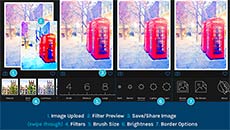
    The app now simulates the spreading and bleeding of the pigment onto the canvas - with dedicated properties for the virtual paper, the pigment, the brushes, the water and so on

    Here's an iPhone app that paints your photos into masterpieces

    3D-printed replica for a safe liver transplant created

    3D-printed replica for a safe liver transplant created
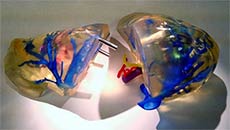
    The 3D-printed liver replicas, made of transparent material threaded with coloured arteries and veins, could help surgeons prevent complications while performing liver transplants or removing tumours, a path-breaking research shows.

    3D-printed replica for a safe liver transplant created

    First Look: World's first winemaker machine for your kitchen!

    First Look: World's first winemaker machine for your kitchen!
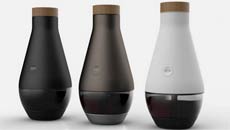
    Three cheers for wine lovers out there. Here comes a new machine that can turn water, grape concentrate, yeast and a finishing powder into wine in your kitchen in flat three days.

    First Look: World's first winemaker machine for your kitchen!