Thursday, December 18, 2025
ADVT 
Tech

Social media helps get science work noticed

Darpan News Desk IANS, 07 Nov, 2014 12:19 PM
    Sharing science work via social media like Twitter is good for researchers in getting their works noticed, shows a study.
     
    Even young scientists are more keen to share their achievements via the social media, showed the study.
     
    "I've been in science communication for a while now, and I am really seeing a change - especially among the younger scientists - in their willingness to share their work," said Dominique Brossard, professor life sciences communication at University of Wisconsin-Madison, US.
     
    There is a link between "h-index" -- a measure of the quality of a researcher's work and influence -- and whether the scientists interact with reporters and get mentioned on Twitter, showed the study.
     
    “Attention from reporters is good news for h-index, but couple that with attention on Twitter, and you see a more pronounced spike in reputation,” stressed Brossard.
     
    Around 30 percent of the members of the faculty at UW-Madison are using social media at least three times per week to find news and insights about science, showed the study.
     
    "What this shows us is that sharing your science with the public is not hurting the science by stealing time," stressed Brossard.
     
    "As in other areas, such as politics for example, social media was once met with scepticism but is increasingly part of the culture," pointed out Michael Xenos from University of Wisconsin-Madison.
     
    If the goal is to encourage people to be productive scientists, and if directors of labs are discouraging people from engaging in this activity, they are actually hurting the science itself. Because people who do this are cited more often in scientific journals, they are making science accessible to broader audiences at the same time, concluded Brossard.
     
    The study appeared in the journal Journalism and Mass Communications Quarterly.

    MORE Tech ARTICLES

    Watch out! Your boss uses social media more than you

    Watch out! Your boss uses social media more than you
    If you log on to your Facebook account while at work, you have now less reason to be apprehensive as researchers have found that top managers are the ones who use private social media most for personal purposes during working hours.

    Watch out! Your boss uses social media more than you

    Why most Facebook users don't recommend products online?

    Why most Facebook users don't recommend products online?
    How often have you recommended a product to your friends and acquaintances on Facebook? Most likely, not very often. And what stopped you is a fear of social censorship, claims a new research.

    Why most Facebook users don't recommend products online?

    Can't put your iPhone away for long? Now, an app is here to de-addict you

    Can't put your iPhone away for long? Now, an app is here to de-addict you
     Can't put your iPhone away for long? Here comes an app that can help you de-addict from your smartphone, freeing up more time for you to spend with your family and friends.

    Can't put your iPhone away for long? Now, an app is here to de-addict you

    App that can make obese people agile

    App that can make obese people agile
    If you are used to a sedentary lifestyle, this app can help you become a little active.

    App that can make obese people agile

    Google makes voice search compatible with Indian diction

    Google makes voice search compatible with Indian diction
    Google Tuesday said it has upgraded the technology under which voice search features become compatible with Indian diction.

    Google makes voice search compatible with Indian diction

    Amnesty International launches app for activists in danger

    Amnesty International launches app for activists in danger
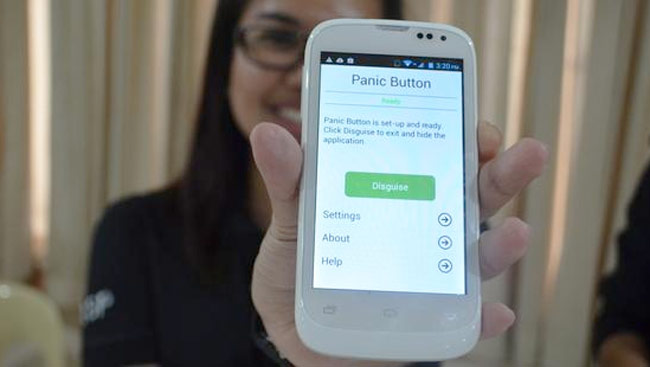
    Amnesty International has launched a new open source app called 'Panic Button’ to help activists facing imminent danger.

    Amnesty International launches app for activists in danger