Thursday, December 18, 2025
ADVT 
Tech

Too Much Texting Bad For Your Spine

Darpan News Desk Darpan, 19 Nov, 2014 01:37 PM
    Simple texting on smartphone can exert nearly 23 kg of pressure on your spine depending on the angle at which you are texting, an alarming research has revealed.
     
    “Loss of the natural curve of the cervical spine leads to incrementally increased stresses about the cervical spine,” wrote study author Kenneth K. Hansraj, a New York-based spinal and orthopaedic surgeon.
     
    Your spine is at its happiest when your ears fall on the same plane as your shoulders and your shoulder blades are retracted.
     
    “Without these adjustments, you put added stress on your spine,” Hansraj added.
     
    During the study, Hansraj calculated how stressful varying degrees of curvature would be on a person’s spine.
     
    At zero degrees of tilt, the resting pressure is equal to the weight of the person’s head - roughly 4.5 kg-5.5 kg.
     
    But for each 15 degrees of tilt, the pressure increases.
     
    At 15 degrees, a person feels 12 kg of pressure; at 30 degrees, it ups to 18 kg.
     
    At 60 degrees, a person should feel roughly 27 kg of force on the spine.
     
    People use mobile devices for roughly two to four hours a day, meaning our necks stay bent for 700 to 1,400 hours in a given year.
     
    “High school students are even worse as they may hit 5,000 hours before they graduate,” Hansraj added.
     
    While it is nearly impossible to avoid the technologies that cause these issues, individuals should make an effort to look at their phones with a neutral spine and to avoid spending hours each day hunched over, the author suggested.
     
    People should stop holding their phones by their waists and surgeons should help minimise post-surgery complications by keeping patient behaviours in mind, Hansraj concluded.
     
    The study appeared in the journal Surgical Technology International.
    MORE Tech ARTICLES

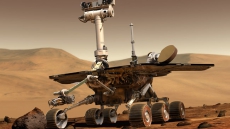
    NASA's Mars rover breaks off-Earth roving record

    NASA's Mars rover breaks off-Earth roving record
    NASA's Opportunity Mars rover that landed on the Red Planet in 2004 now holds the off-Earth roving distance record after trekking for 40 km....

    NASA's Mars rover breaks off-Earth roving record

    Wireless cooling: Magnets to keep your fridge cool

    Wireless cooling: Magnets to keep your fridge cool
    Magnets may soon act as wireless cooling agents for your refrigerators, laptops and other devices if a theory propounded by researchers at Massachusetts...

    Wireless cooling: Magnets to keep your fridge cool

    Human-induced water vapour next climate threat

    Human-induced water vapour next climate threat
    The rising levels of water vapour in the upper troposphere - a key amplifier of global warming - owing to greenhouse gases will intensify climate change...

    Human-induced water vapour next climate threat

    Facebook favoured for background check on prospective partner: Survey

    Facebook favoured for background check on prospective partner: Survey
    Almost fifty percent unmarried people in India use social networking site Facebook to conduct a background check on their prospective partner...

    Facebook favoured for background check on prospective partner: Survey

    2.5 bn smartphone users globally by 2015: US report

    2.5 bn smartphone users globally by 2015: US report
    Nearly 2.5 billion people or 35 percent of the global population is expected to use smartphones by the end of 2015, says the latest report of US-based industry...

    2.5 bn smartphone users globally by 2015: US report

    New technique to build 'invisible' materials with light

    New technique to build 'invisible' materials with light
    A new method of building materials using light could one day enable technologies that are often considered the realm of science fiction, such as invisibility ...

    New technique to build 'invisible' materials with light