Thursday, December 25, 2025
ADVT 
Tech

Two Indians MIT Researchers' Chip Powers Wearable Device To Guide Visually-Impaired

Darpan News Desk IANS, 05 Feb, 2016 12:31 PM
    Researchers, including two Indians, at the Massachusetts Institute of Technology (MIT) have developed a low-power chip that could help visually-impaired people navigate their environments.
     
    The chip processes 3-D camera data consuming only one-thousandth as much power as a conventional computer processor executing the same algorithms and powers a prototype of a complete navigation system about the size of a binoculars case that can be worn around the neck. 
     
    A mechanical Braille interface developed at MIT's Computer Science and Artificial Intelligence Laboratory (CSAIL) conveys to the user information about the distance to the nearest obstacle in the direction the user is moving.
     
    "There was some prior work on this type of system, but the problem was that the systems were too bulky," said first author Dongsuk Jeon, a researcher at MIT's Microsystems Research Laboratories (MTL) when the navigation system was developed. He has now joined the faculty of Seoul National University in South Korea. 
     
    Jeon's team included professor of electrical engineering and computer science Anantha Chandrakasan, graduate student Priyanka Raina, professor of electrical engineering and computer science Daniela Rus, former research scientist at MTL Nathan Ickes and CSAIL researcher Hsueh-Cheng Wang. 
     
    Although the prototype navigation system is less obtrusive than its predecessors, it should be possible to miniaturise it even further, according to the researchers. 
     
    The new chip and the prototype navigation system was reported in a paper presented at the International Solid-State Circuits Conference held from January 31 to February 4 in San Francisco.

    MORE Tech ARTICLES

    Revealed: How black holes are formed

    Revealed: How black holes are formed
    What is more, all these stars have magnetic fields. And these are intensified further if they rotate rapidly, as in the case of the LGRBs.

    Revealed: How black holes are formed

    Spectacular! Watch how earth looks from space

    Spectacular! Watch how earth looks from space
    Everyone has dreamt of looking at the ‘Blue Plant’ from up there. Now you can watch earth live - as viewed from space.

    Spectacular! Watch how earth looks from space

    Now, a perfume radar to sense new scents

    Now, a perfume radar to sense new scents
    Creating those extravagant perfumes that exude an aura of elegance around those who wear them may no longer be the fiefdom of a few experts.

    Now, a perfume radar to sense new scents

    Virtual humans to transform global health care soon

    Virtual humans to transform global health care soon
    Expensive experimental tests often prescribed by physicians may soon become things of the past as scientists have now come closer to creating an in silico replica of the human body that would enable the virtual testing of bespoke treatments.

    Virtual humans to transform global health care soon

    Amazing! An Umbrella that gives you rain data via smart phone!

    Amazing! An Umbrella that gives you rain data via smart phone!
    Though rains are still some days away, buying this umbrella that can collect rain data won't be a bad idea.

    Amazing! An Umbrella that gives you rain data via smart phone!

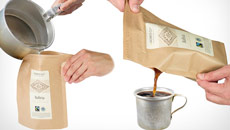
    Now, a disposable 'coffee machine' at your service

    Now, a disposable 'coffee machine' at your service
    If a cup of filter coffee is what you need the most to get your day started, you no longer have to worry about travelling to the nearest coffee shop. A Danish designer has come up with a disposable coffee machine that works just like a tea bag for coffee.

    Now, a disposable 'coffee machine' at your service