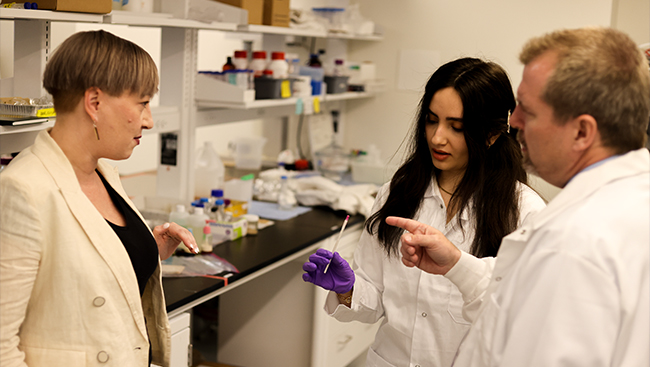
A team of researchers at the University of British Columbia want to make a stir stick drug testing tool for spiked drinks the norm in the hospitality industry, and they're gearing up to start "real-world testing" in hopes of commercializing the idea.
The device called "Spikeless" was developed in the university's faculty of applied science, and the inventors hope for widespread adoption to combat drugs being added to drinksand to prevent sexual assaults.
The university said in a news release that the "seemingly ordinary stir stick" can detect drugs such as GHB and ketamine, changing colour if a beverage is contaminated.
Sasha Santos, an anti-violence activist working with the researchers on the project, said other drug testing tools are marketed to individuals in a problematic way.
"In the anti-violence sector, you know, there's a lot of very strong feelings about people who are being targeted with violence being told that the burden of safety is on them, and that they have to buy more and do more to protect themselves constantly," she said.
Santos said targeting the hospitality industry at large, including bars, pubs, clubs and other party venues where drinks flow freely, means patrons can have access to a simple drug testing tool for "every cocktail on every table."
"The idea is that it'll be completely ubiquitous," she said. "Every drink leaving the bar will have a stick in it. Every drink will be stirred, every drink will be tested, every drink will be safe."
The stick's co-inventor Samin Yousefi, a masters student at the university, says the stick will offer a discreet means of testing drinks compared with similar inventions, such as cups, coasters or straws developed to detect drugged drinks.
Yousefi said they've filed a patent and are starting a company to commercialize the product, but it's still in the prototype stage and going through laboratory tests.
The concept for the invention was devised by Johan Foster, an associate professor of chemical and biological engineering, and his brother, in 2011, and a prototype has been in the works for the last three years.
Santos and Yousefi said the sticks will be cheap and comparable to the price of regular straws and stir sticks, but they're still searching for the capital to successfully commercialize the idea.
Santos said the State of California has a law that requires bars to provide patrons with drugged drink testing tools, and she'd "love to see Canadian lawmakers follow suit."
Police across Canada have issued numerous warnings about drugged drinks, and RCMP in Nanaimo, B.C., launched a public awareness campaign this month after "several reports" of drinks being drugged at nightclubs in that area.
This report by The Canadian Press was first published March 27, 2025.