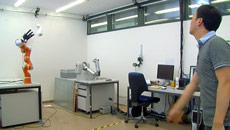
VANCOUVER — Virtual reality could be the next instrument in a hospital's arsenal of cost-fighting tools as nurse teams demo a surgery simulator that makes training feel like a video game.
Surrey Memorial Hospital and several U.S. medical centres are testing software invented by a British Columbia tech company that provides an immersive 3D environment, which it says can replace traditional practice spaces.
"You no longer have to spend the cost of operating room time to get the operating room experience," said Aaron Hilton, executive chairman of Conquer Mobile, of its tool PeriopSim.
"We're trying to save B.C. from its nursing shortage by saving the province millions in nursing training."
The invention, which Hilton displayed at a tech conference in Vancouver on Tuesday, is at the forefront of advancements in medical technology. It's just one example of how B.C. high-tech companies say innovations could help make health care more affordable.
At the University of Victoria, biomedical engineers have founded a non-profit that's striving to bring 3D technologies to developing countries to manufacture prosthetics for impoverished amputees.

The Victoria Hand Project equips doctors to 3D scan of a plaster mold of a patient's residual limb. The doctor can then use that image to create a custom-fitted 3D-printed socket.
The invention has been trialed with victims of drug-related violence in Guatemala and people injured by traffic accidents in Nepal.
Traditional prosthetic costs can be as high as $10,000, but the new prosthetic can be printed, assembled and delivered for $320, says project director Joshua Coutts.
"Compared to what's out there now, this is a substantial savings," he said.
Technological advancements have hit a point where many costs are dropping based on increased competition among innovators, said Prof. Siamak Arzanpour of Simon Fraser University in Burnaby, B.C.
His team had to find cost-effective solutions while designing a robotic exoskeleton that assists people with lower-body disabilities, which he likened to the film character "Iron Man."

"By attacking real problems, we are reducing the burden for government and for the health-care system," added Arzanpour, who's in the school of mechatronic systems engineering.
Automation is another potential cost-saver. One case is a company that makes equipment for the pharmaceutical industry, which uses robotics to fill vast quantities of containers with injectable medicines.
Christopher Procyshyn, CEO of Vanrx Pharmasystems Inc., said cutting out humans is not only more precise but cheaper. He compared decreased costs to deploying a drone instead of a fighter plane.
Procyshyn added that when drug therapies tend to be more costly themselves, they may produce savings by being more effective.
"The story is becoming more common — people living with cancer, people overcoming cardiac issues, people spending longer term having better therapies and better lifespans," he said.
"From a health-economics standpoint, what does it cost now? The pharmaceutical is more expensive but (patients are) not in the hospital, they're not in surgery."
In other instances, costs have dropped dramatically.
Startup firm Perked! has developed a mobile app that functions as a mental-fitness coach, called Ava.
The company worked with a neuroscientist at the University of British Columbia to create activities based on research that are designed to enhance a person's mental health and happiness.

The product is an example of something that is cost-effective to develop and that could save money for the health-care system, said CEO Jane Chung.
"Technology can provide accessible and personalized medicine to enhance well-being, which affects costs that might otherwise be borne by the community."